North Korea Fires Multiple Ballistic Missiles Into East Sea; USINDOPACOM Says No Immediate Threat to US
North Korea launched multiple ballistic missiles toward waters off its east coast on Sunday, April 19, 2026, according to a statement released by U.S. Indo-Pacific Command. The command said the launches pose no immediate threat to U.S. personnel or territory, and that it is consulting with allies. The launches follow a cluster of short-range ballistic missile tests on April 7–8.
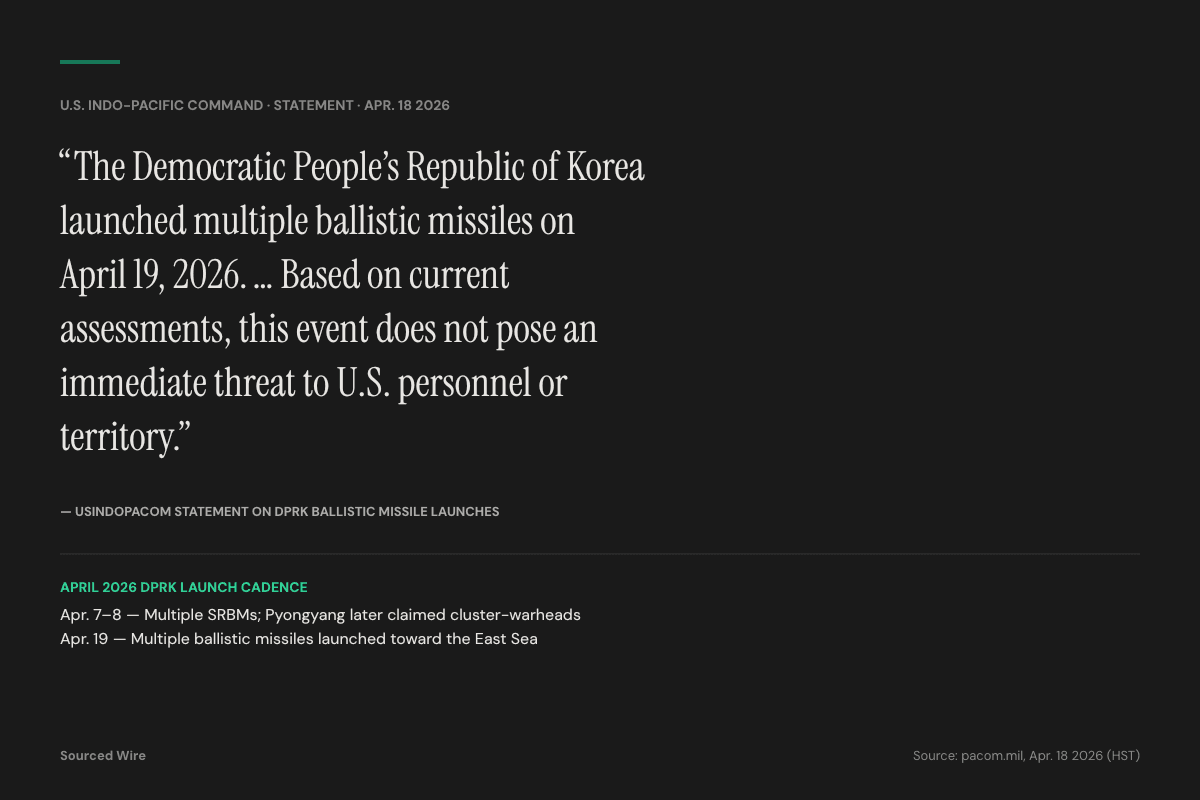
The Democratic People's Republic of Korea launched multiple ballistic missiles toward waters off its east coast on Sunday, April 19, 2026, according to a statement released by U.S. Indo-Pacific Command (USINDOPACOM).
USINDOPACOM's statement, posted to pacom.mil and dated April 18, 2026 (Hawaii time):
The Democratic People's Republic of Korea launched multiple ballistic missiles on April 19, 2026. We are aware of the missile launches and are consulting closely with our allies and partners. Based on current assessments, this event does not pose an immediate threat to U.S. personnel or territory.
The statement does not specify the number of missiles, trajectory, or range. South Korean Yonhap News Agency initially reported the tracking of an "unidentified ballistic missile" fired eastward; USINDOPACOM's characterization of "multiple" missiles suggests the initial single-track read may have resolved into more than one by the time the US command issued its formal statement.
Context
The April 19 launch is at least the third distinct ballistic-missile event from North Korea in April 2026:
| Date | Event |
|---|---|
| April 7–8 | Multiple short-range ballistic missiles (SRBMs) fired over three days of exercises; Pyongyang later claimed some of the missiles carried cluster-bomb warheads |
| April 19 | "Multiple" ballistic missiles launched toward the East Sea, per USINDOPACOM |
The April 7–8 cluster followed Pyongyang's designation of South Korea as its "most hostile enemy" and coincided with South Korea–US military drills. North Korea has conducted at least one major ballistic-missile test every month of 2026, beginning with a launch on January 4.
South Korea's Joint Chiefs of Staff and Japan's Ministry of Defense typically issue launch-specific bulletins with flight-distance, apogee, and impact-area readouts; as of this writing those granular details had not been published in English.
What USINDOPACOM routinely says
The "no immediate threat to U.S. personnel or territory" framing is the standard INDOPACOM language for DPRK launches whose trajectory stays inside regional waters. Paired with the consultation-with-allies clause, it indicates the US assesses the event as a regional signaling test rather than a strategic-range or nuclear-delivery demonstration. The statement does not contain the language INDOPACOM deploys when an ICBM or long-range missile is involved — which typically includes specific assessments of maximum altitude and range and reaffirmation of US Ballistic Missile Defense posture.