Joint UN-EU-World Bank Assessment Puts Gaza Reconstruction at $71.4 Billion Over Ten Years; Human Development Set Back 77 Years
The Final Gaza Rapid Damage and Needs Assessment, released April 20, quantifies 24 months of war: the economy has contracted 84%, 371,888 housing units are damaged or destroyed, unemployment is above 80%, and $26.3 billion is needed in the first 18 months alone to restore basic services.
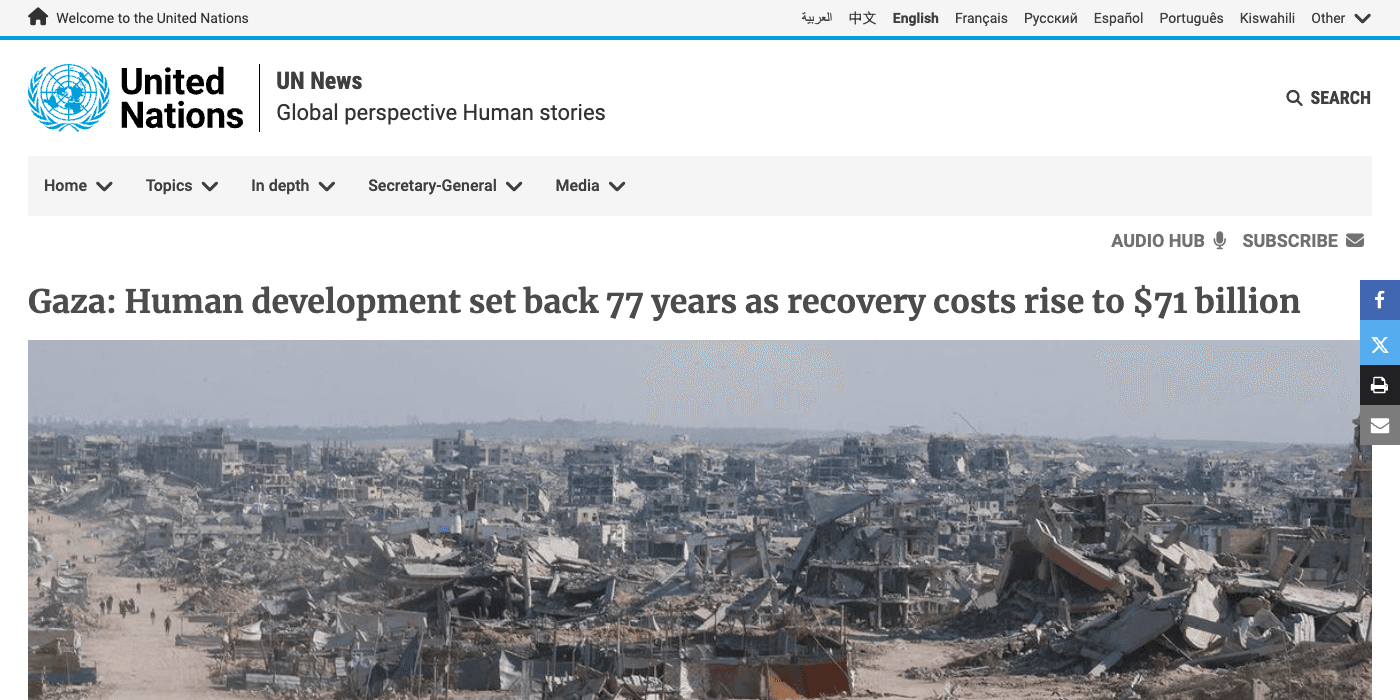
The European Union, the United Nations, and the World Bank on April 20, 2026 released the Final Gaza Rapid Damage and Needs Assessment (RDNA), the joint post-conflict accounting of damages, economic losses, and recovery needs across the Gaza Strip after 24 months of war.
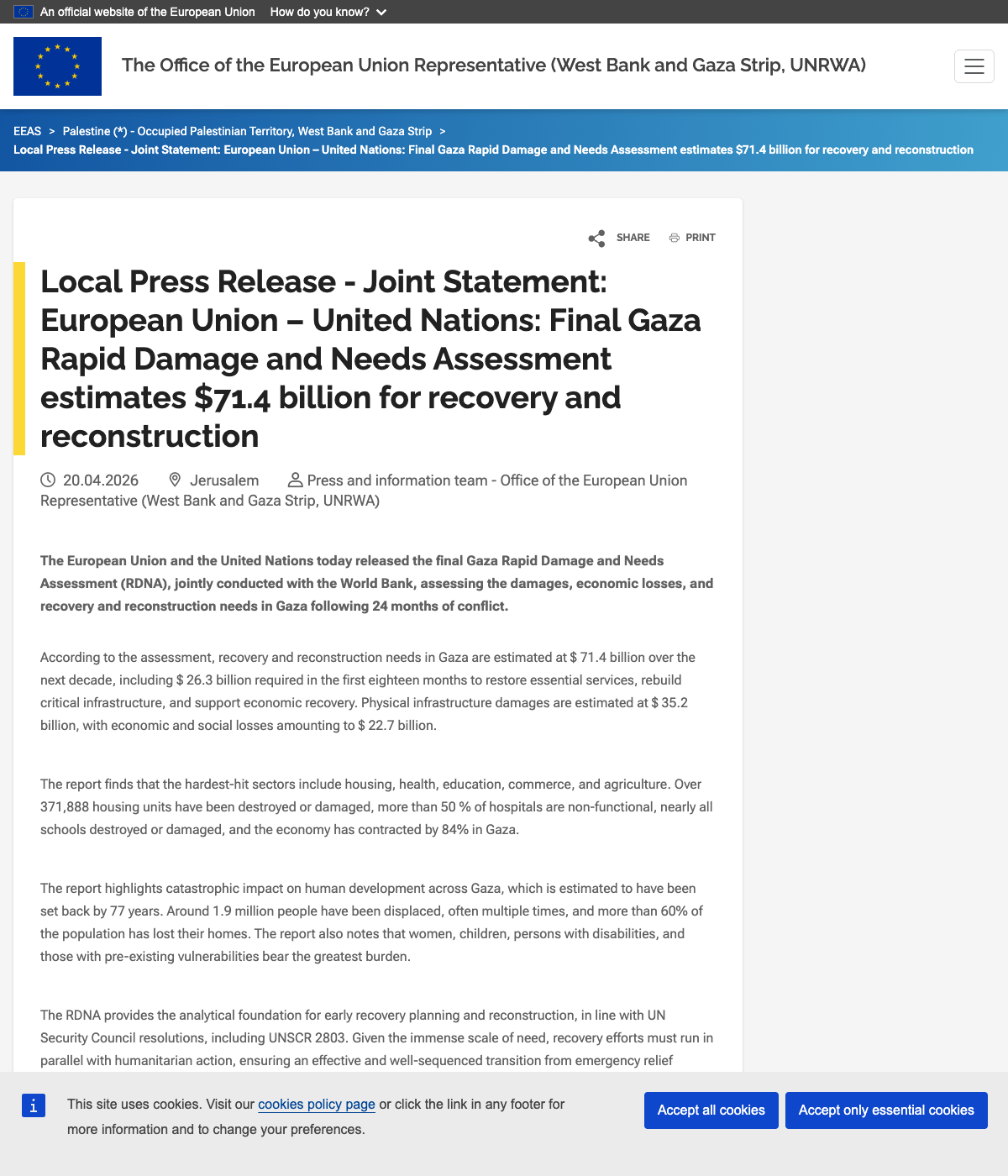
Total recovery and reconstruction needs are estimated at $71.4 billion over ten years. Of that, $26.3 billion is required in the first 18 months to restore essential services and begin rebuilding.
The damage, in numbers
| Category | Figure |
|---|---|
| Total recovery and reconstruction needs (10 years) | $71.4 billion |
| Immediate needs (first 18 months) | $26.3 billion |
| Physical infrastructure damages | $35.2 billion |
| Economic and social losses | $22.7 billion |
| Housing units destroyed or damaged | 371,888 |
| Hospitals non-functional | >50% |
| Schools destroyed or damaged | Nearly all |
| Economy contraction | 84% |
| Unemployment | >80% |
| Displaced persons | ~1.9 million |
| Population that has lost their homes | >60% |
| Human Development Index regression |
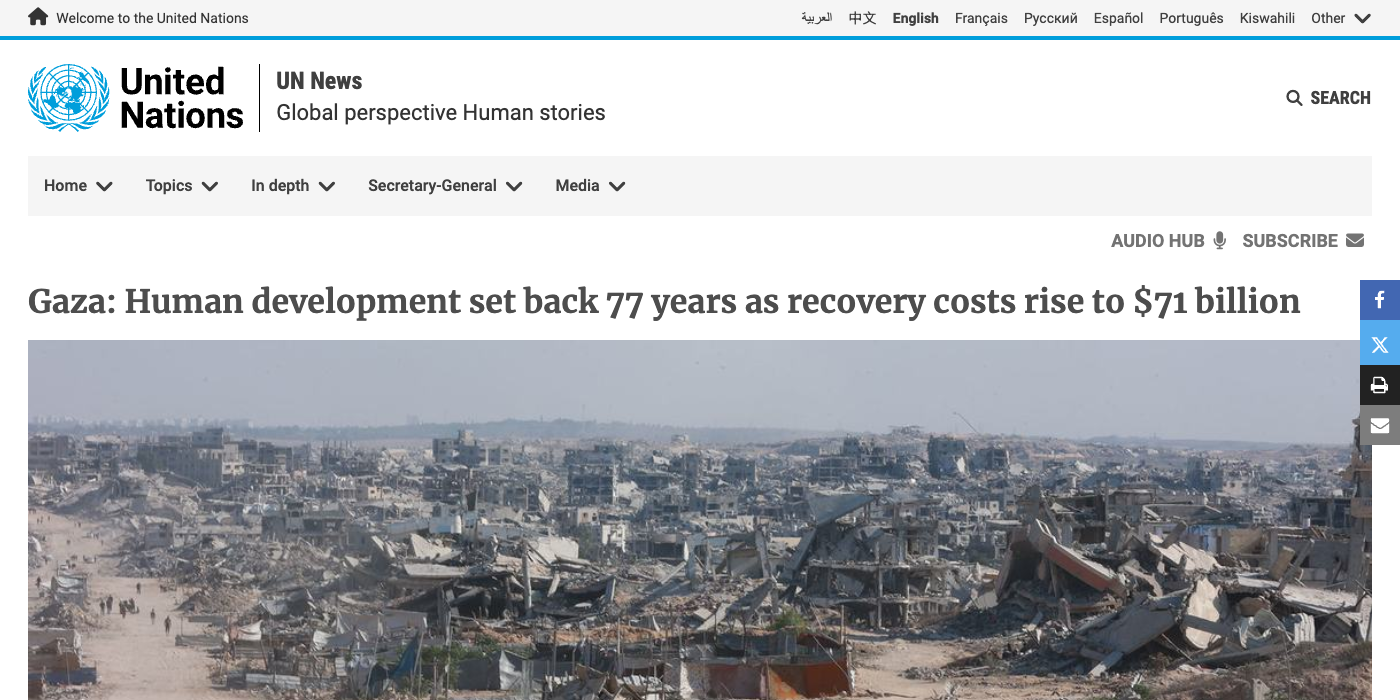
The hardest-hit sectors identified by the assessment are housing, health, education, commerce, and agriculture.
The 'survival economy'
A companion UN News feature published alongside the RDNA documents how Gaza's educated workforce is absorbing the collapse. Professionals and graduates — electrical engineers, accountants, university graduates — are running spice stalls, selling sweets, cleaning supplies, and stationery to buy daily necessities. The Palestinian Central Bureau of Statistics recorded a 37.9 percent jump in basic commodity prices in February 2026 alone.
"After struggling in university for years, we had dreams and ambitions to achieve what we aspired to," Abdullah al-Khawaja, an electrical engineering graduate now operating a spice stall, told the UN.
The governance framework
The RDNA specifies that recovery and reconstruction should be Palestinian-led and align with UN Security Council Resolution 2803 and the so-called Comprehensive Plan — the governance framework endorsed by the Council for the transition to Palestinian Authority control. The assessment endorses "build-back-better" and "build-forward-better" approaches in service of a two-state political settlement.
The joint statement was issued by Alexandre Stutzmann, Head of Delegation of the European Union Representative to the West Bank and Gaza Strip, and Ramiz Alakbarov, the UN's Deputy Special Coordinator for the Middle East Peace Process, Resident Coordinator, and Humanitarian Coordinator.
Context
The Final RDNA is the third and culminating assessment in a sequence (Interim RDNA released in 2024; Interim RDNA 2 in early 2025) produced by the same tripartite — EU, UN, and World Bank — using satellite imagery, administrative records, and ground surveys to quantify loss. This version covers the full duration of the conflict. The $71.4 billion estimate compares to pre-war Gaza GDP of roughly $2.6 billion (2022, World Bank), implying a reconstruction cost on the order of 27 times the territory's last pre-war annual output.