Bipartisan House bill would create a Taiwan undersea cable protection initiative, authorize $120M and new sanctions against saboteurs
HR 8177, introduced April 2 by Rep. Michael Lawler (R-NY) with two Democratic cosponsors, directs the State Department to establish a Taiwan Critical Undersea Infrastructure Resilience Initiative and authorizes sanctions against foreign persons responsible for cable sabotage.
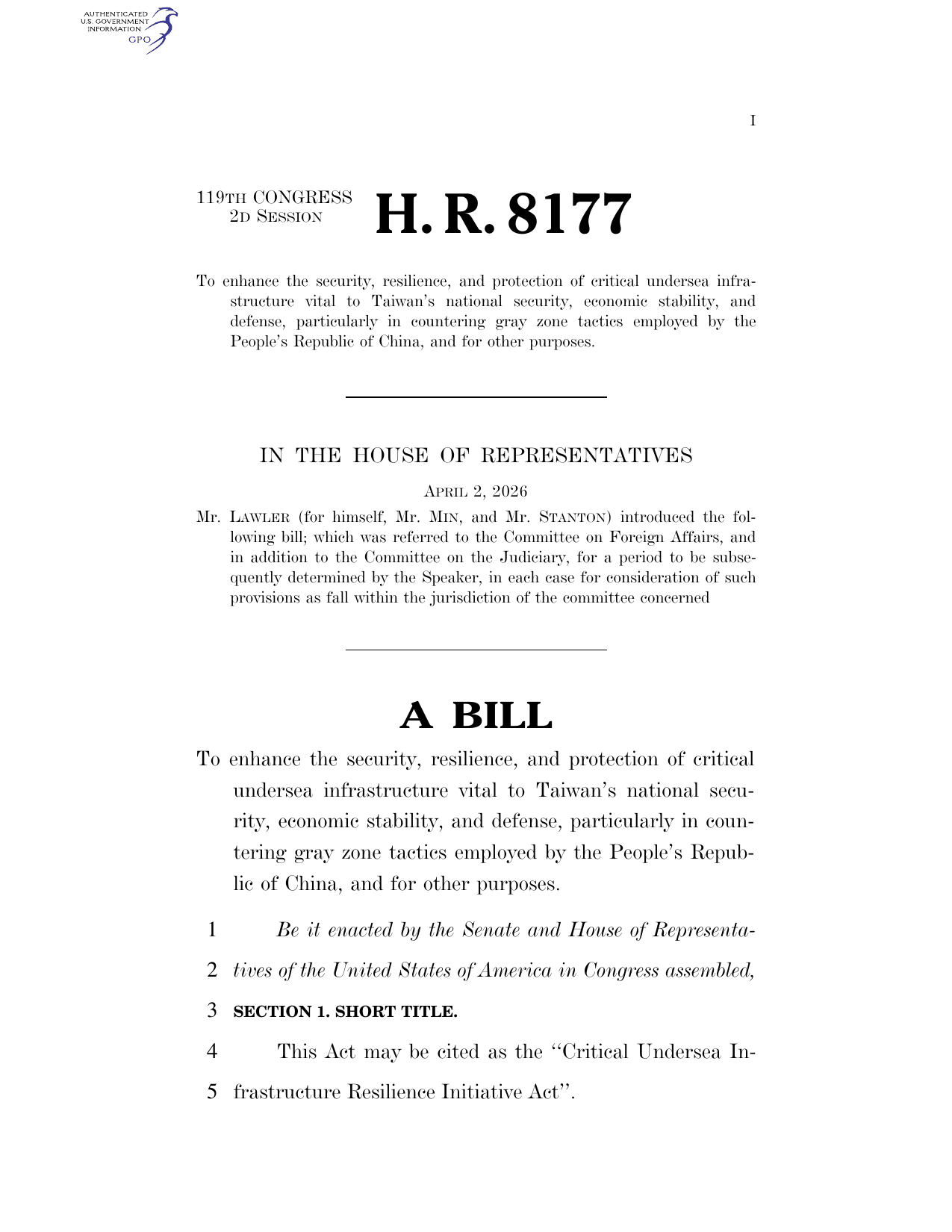
Rep. Michael Lawler (R-NY-17) introduced HR 8177, the Critical Undersea Infrastructure Resilience Initiative Act in the House on April 2. It was joined by two Democratic cosponsors the same day -- Reps. Dave Min (D-CA-47) and Greg Stanton (D-AZ-4) -- and referred to the House Foreign Affairs and Judiciary committees.
The bill is aimed squarely at Taiwan. Its findings section catalogues at least 11 incidents of undersea cable damage near Taiwan since 2023, including suspected sabotage around the Matsu Islands in 2023 and 2025 and near Taipei in January 2025. It also notes that similar incidents in the Baltic Sea "suggest possible PRC-Russian coordination" on undersea infrastructure attacks.
What the bill does
The centerpiece is a new Taiwan Critical Undersea Infrastructure Initiative that the Secretary of State must establish within 360 days of enactment, in coordination with Defense, Homeland Security, and the Coast Guard. The initiative is organized around five focus areas:
- Advanced monitoring -- real-time detection systems for disruptions and suspected sabotage, with early-warning intelligence shared with Taiwan.
- Rapid response protocols -- logistical capacity to conduct quick repairs on damaged infrastructure.
- Maritime domain awareness -- Navy and Coast Guard presence around Taiwan, joint patrols, and surveillance in the Taiwan Strait.
- International frameworks -- cooperative protection arrangements with regional partners, joint drills, and intelligence-sharing.
- Cable hardening -- encouraging reinforced cables, deeper burial depths, and more resilient materials.
The bill authorizes $20 million per year for fiscal years 2027 through 2032 -- $120 million over the six-year window -- specifically for the rapid response and logistics work.
Sanctions authority
HR 8177 would give the President sanctions authority against "any foreign person responsible for sabotage or facilitating sabotage against Taiwan's critical undersea infrastructure." That includes:
- Vessel owners and operators that commit sabotage
- Providers of insurance, underwriting, port services, documentation, or ship captains involved
- Persons conducting preparatory surveillance or logistical support
Available sanctions include asset blocking under the International Emergency Economic Powers Act (IEEPA), visa denial, and criminal penalties. Within 15 days of imposing any sanction, the President must submit a detailed justification to Congress. Standard exceptions apply for UN obligations, law enforcement, and intelligence activities, and the President retains a national security waiver.
Reporting requirements
The bill would generate two streams of reports to Congress over a decade:
- A semiannual report starting 180 days after enactment through 2032, detailing sabotage incidents near Taiwan and US responses.
- An annual classified cross-strait contingency planning report for 10 years, covering scenario planning, preparedness assessments, capability gaps, and lessons learned.
How the bill defines its terms
Critical undersea infrastructure is defined broadly: subsea energy cables and pipelines transmitting electricity, gas, oil, or hydrogen; subsea telecommunications fiber-optic cables; and associated landing stations.
Sabotage covers both physical damage and "defective production" or operation of such systems, including attacks on data integrity -- language that extends the bill beyond cable-cutting to cover cyber and supply-chain attacks on undersea infrastructure.
Context
The bill was introduced one week before the UK Ministry of Defence's April 9 public disclosure that Royal Navy and Norwegian forces had been tracking Russian submarines near British waters and critical undersea infrastructure. HR 8177's findings explicitly invoke the Baltic Sea incidents as part of a broader pattern that includes the Taiwan Strait attacks. The bill treats the two theatres -- North Atlantic / Baltic and Taiwan Strait -- as parts of the same problem.
The bipartisan cosponsor list is unusually balanced for a China-focused foreign policy bill: one Republican (Lawler, a member of the House Foreign Affairs Committee), two Democrats (Min, Stanton). HR 8177 is now awaiting committee action.