New preprint argues Kepler's sub-Neptune exoplanets hide a 'valley' in their orbital distances, pointing to standing waves in protoplanetary disks
A two-paper preprint series from Li Zeng (Harvard) and collaborators re-analyzes Kepler mission data and reports a deficit of sub-Neptunes at specific orbital distances. The authors interpret the pattern as evidence of standing waves in the protoplanetary disks where planets form, analogous to the ring structures ALMA has imaged at larger scales.
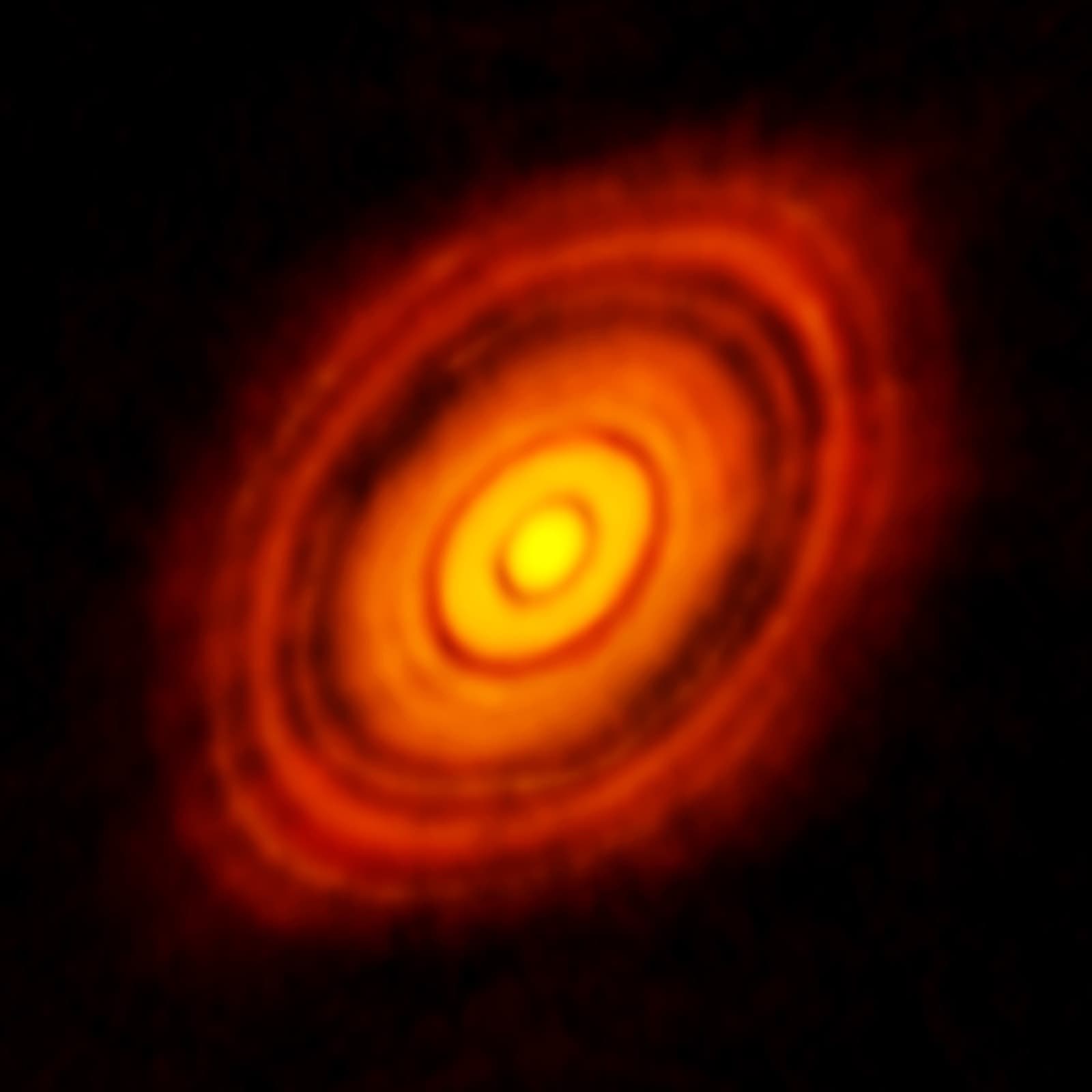
A two-part arXiv preprint posted April 9 claims that the distribution of sub-Neptune exoplanets around Sun-like stars contains a previously unrecognized "valley" -- a gap in the range of orbital semi-major axes where sub-Neptunes are observed. The authors argue this pattern is consistent with long-range standing waves in the protoplanetary disks where planets form.
The papers are:
- Part I: Exoplanet Orbital Distribution around FGK Sun-like Host Stars I: planet occurrence rate derived from the Kepler Mission and theoretical interpretations from planet formation
- Part II: Exoplanet Orbital Distribution around FGK Sun-like Host Stars II: a valley in the orbital semi-major axis distribution of sub-Neptunes
Both are authored by Li Zeng (Harvard Department of Earth and Planetary Sciences), Stephanie C. Werner, Reidar G. Trønnes, and Elena Mamonova (University of Oslo), Stein B. Jacobsen (Harvard), and Ramon Brasser.
What Part I finds
Using survival-function statistical analysis on Kepler mission data, the authors report that the orbital period (and semi-major axis) distribution of the majority of non-giant planets around FGK stars -- the Sun-like spectral classes -- is approximately log-uniform. In plain terms: small and intermediate-sized planets are found at roughly equal probability per decade of orbital distance. The exception is giant planets, which follow a different distribution.
This is a baseline result. The known dearth of planets near two Earth radii -- the well-established radius valley -- is a separate feature that affects planet sizes, not distances.
What Part II claims
Part II's central finding is a new valley in the semi-major-axis distribution of sub-Neptunes. Where planets would be expected based on the log-uniform baseline, the authors report a measurable deficit at specific distances from the host star. Writing in the abstract, they say:
"More than one hundred years ago, physics has been revolutionized when people realized that electronic orbitals, or electromagnetic interactions in general, are quantized. Now, in this study, we are presenting evidence of quantization of planet orbits around stars."
The word quantized is being used analogously rather than in the strict quantum-mechanical sense. Their proposed mechanism is classical: confining any wave in a bounded region selects discrete wavelengths, and the authors argue the disk where planets form hosts long-range standing waves at orbital distances below 1 AU.
Connection to ALMA ring observations
The authors note that the Atacama Large Millimeter Array (ALMA) has already imaged ring-like structures in protoplanetary disks at larger scales -- tens of AU from the host star. The best-known example is the young star HL Tauri, whose disk was resolved by ALMA in 2014 into concentric dust rings separated by gaps. If similar standing-wave structures exist at smaller scales within 1 AU, the authors argue, they could shape where sub-Neptunes end up settling into stable orbits.
The paper does not report new ALMA observations inside 1 AU -- it infers the existence of such structures from the statistical pattern in Kepler's planet catalog.
Caveats
Both papers are preprints and have not yet been through peer review. The statistical interpretation of the Kepler occurrence-rate data is sensitive to detection biases in how Kepler observes transiting planets, and the authors' strong framing -- "quantization" and "standing waves" -- is a physical interpretation that other groups will want to examine before accepting.
The more conservative reading is that Part II reports a statistical feature in the sub-Neptune semi-major-axis distribution that, if real, warrants a physical explanation. Whether that explanation is standing waves in the disk, a birth-location effect from orbital migration, or a selection artefact is the question the rest of the field will now work through.