Texas state unemployment fund starts borrowing from Treasury for first time since COVID, balance up to $299M in five weeks
The Texas Workforce Commission's unemployment trust fund took its first Title XII advance from the federal Treasury on March 4, 2026 -- the first time since the COVID-era borrowing was repaid. The balance has climbed to $299M as of April 8, averaging roughly $57M per week.
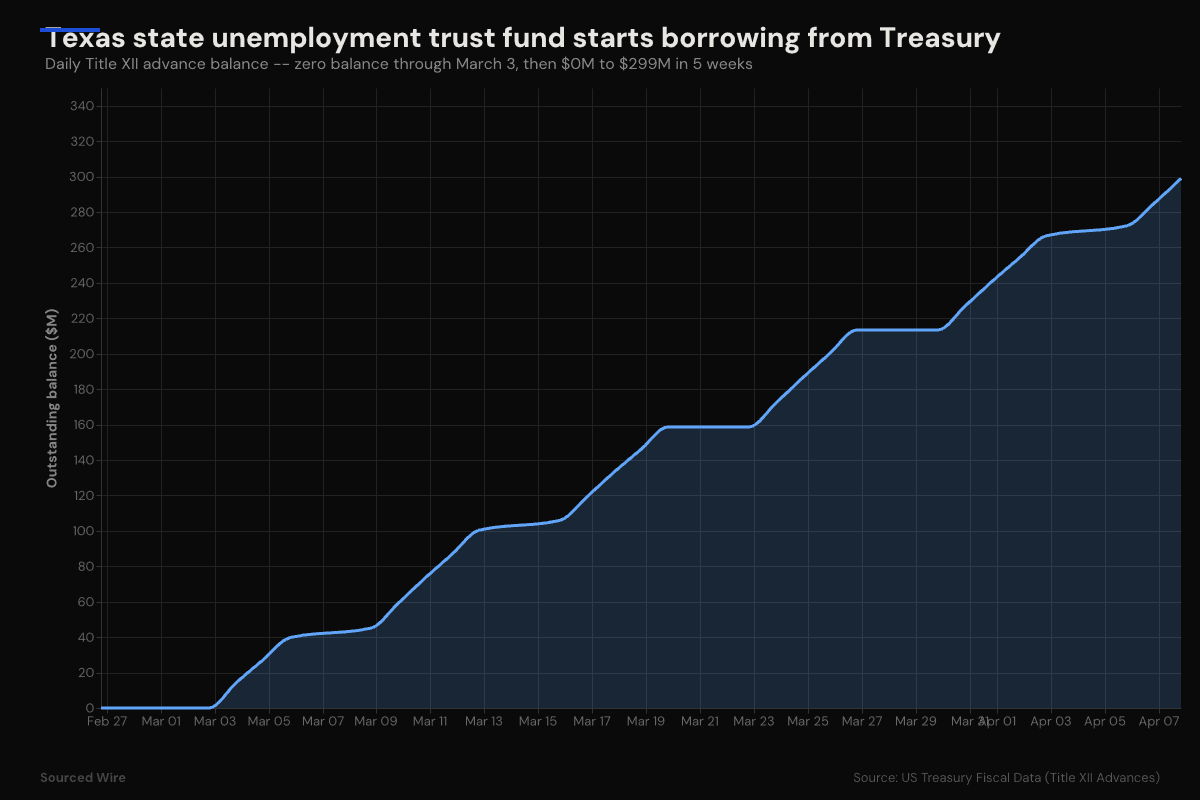
Texas state unemployment trust fund began borrowing from the federal Treasury on March 4, 2026, according to Treasury's daily Title XII advance data. The balance has grown from zero to $298.95 million over the five weeks since, tracked in the Treasury's Title XII advances dataset.
It is the first time Texas has held a Title XII balance since its previous COVID-era borrowing was paid off. Between 2020 and early 2022 Texas had a multi-billion-dollar balance, which was cleared during the pandemic recovery. The fund remained at zero throughout 2025 and the first two months of 2026.
Connecticut also appeared on the Title XII ledger for the first time in 10 months on the same day, March 4, with a much smaller balance now at $72.3 million.
What Title XII means
Title XII of the Social Security Act allows states whose unemployment insurance trust funds are running low to borrow from the federal Unemployment Trust Fund. States pay interest (currently 3.189%), and the loans are eventually repaid from employer payroll taxes. A state's Title XII balance is a direct signal that its unemployment insurance program is paying out benefits faster than it is collecting premiums -- usually because a combination of rising claims and a depleted reserve.
The balance is updated daily by Treasury and is one of the few near-real-time indicators of state-level labor-market stress.
The trajectory in Texas
Texas's balance has climbed steadily each business day since March 4, averaging $57 million per week:
| Week ending | Texas balance | Weekly change |
|---|---|---|
| Mar 6 | $40M | +$40M |
| Mar 13 | $100M | +$60M |
| Mar 20 | $159M | +$59M |
| Mar 27 | $213M | +$55M |
| Apr 3 | $267M | +$53M |
| Apr 8 | $299M | +$32M (3 business days) |
The pace has not slowed meaningfully. At the current rate of roughly $57 million per week, Texas would cross $500 million by late May and $1 billion by the end of July.
All four states currently borrowing
As of the April 8 Treasury data:
| State | Outstanding balance | Interest rate |
|---|---|---|
| California | $20,935.7M | 3.189% |
| Texas | $299.0M | 3.189% |
| Connecticut | $72.3M | 3.189% |
| Virgin Islands | $13.0M | 3.189% |
| Total | $21,320M |
California has been borrowing continuously since September 2, 2025 and is the only state on the ledger through most of 2025. Its balance has been slowly drawing down -- from $21.76 billion at the end of February to $20.94 billion on April 8 -- while Texas and Connecticut are moving in the opposite direction.
What it signals
Texas's labor market has been among the strongest in the country by most headline measures. For its unemployment trust fund to flip from surplus to deficit in the span of a few months implies either a sharp increase in claims, an unusually thin trust fund cushion going into 2026, or both. The Texas Workforce Commission publishes its unemployment insurance trust fund data with a lag; the Treasury's Title XII data runs roughly two days behind the present and is the first publicly-available signal that the state-level fund is drawing on federal credit.
The nearly-simultaneous arrival of Texas and Connecticut on the ledger -- on the same business day -- is a detail worth watching. Title XII entries are driven by state-specific trust fund draws and do not typically cluster across unrelated states, which makes the matching start date unusual enough to note.
Wire will track this series weekly.