CBP Opens Tariff Refund Portal for $166 Billion in IEEPA Duties Struck Down by Supreme Court
Customs and Border Protection launched Phase 1 of its CAPE refund tool at 8 a.m. Monday, letting more than 330,000 importers file claims for duties the Supreme Court invalidated in February.
U.S. Customs and Border Protection on Monday morning opened the first window for American importers to claim refunds of tariffs the Supreme Court struck down in February. The Consolidated Administration and Processing of Entries tool, known as CAPE, went live inside the agency's ACE Secure Data Portal at 8:00 a.m. Eastern, allowing Importers of Record and licensed customs brokers to submit batch refund declarations for duties collected under the International Emergency Economic Powers Act.
CBP has estimated that more than 330,000 importers paid up to $166 billion in IEEPA duties on 53 million shipments before the tariffs were invalidated. The agency said that as of April 9, 56,497 importers had completed the pre-filing steps — registering bank information in ACE and confirming account access — required to receive electronic refunds, covering roughly $127 billion of the total at stake.
What Phase 1 covers
CAPE is being rolled out in stages. Phase 1, which opened Monday, is limited to two categories of entries: entries that remain unliquidated — meaning CBP has not yet finalized the duty calculation — and entries liquidated within the preceding 80 days. CBP has told filers that Phase 1 covers approximately 63 percent of all IEEPA duties paid.
Entries liquidated more than 80 days before the launch are outside the scope of Phase 1 and will be addressed in later releases of the tool. CBP has not published a timeline for the subsequent phases.
How the refund process works
A CAPE Declaration is submitted as a comma-separated values file through the filer's ACE Portal account. Only the Importer of Record that filed the original entry, or the licensed customs broker who filed on their behalf, is eligible to submit a declaration. CBP has said both parties must ensure an ACE account is active and that bank information for electronic funds transfer is on file before the declaration can be processed.
Approved refunds are paid by Automated Clearing House transfer. The agency has said valid claims will be refunded within 60 to 90 days of approval.
The ruling behind the refunds
The refund program exists because of Learning Resources, Inc. v. Trump, 607 U.S. ___ (2026), decided February 20, 2026. In an opinion by Chief Justice John Roberts, the Supreme Court held by a 6-3 vote that IEEPA — a 1977 statute authorizing the president to regulate commerce during foreign-threat national emergencies — does not grant the authority to impose tariffs.
The decision affirmed a lower-court ruling that invalidated two sets of duties the Trump administration imposed under the law: tariffs on imports from Canada, Mexico, and the People's Republic of China, based on declared emergencies over illicit drug flows; and tariffs on most other U.S. imports, based on a declared emergency over the U.S. trade deficit.
Tariff policy since the ruling
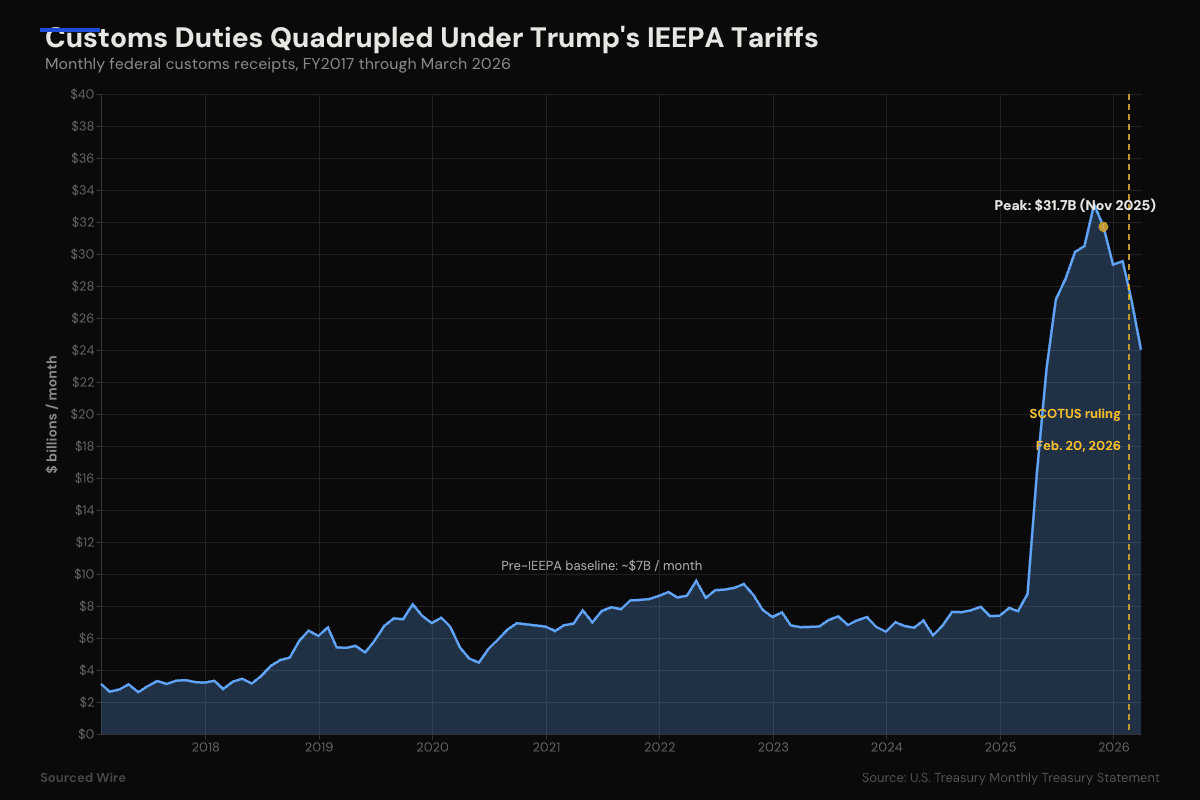
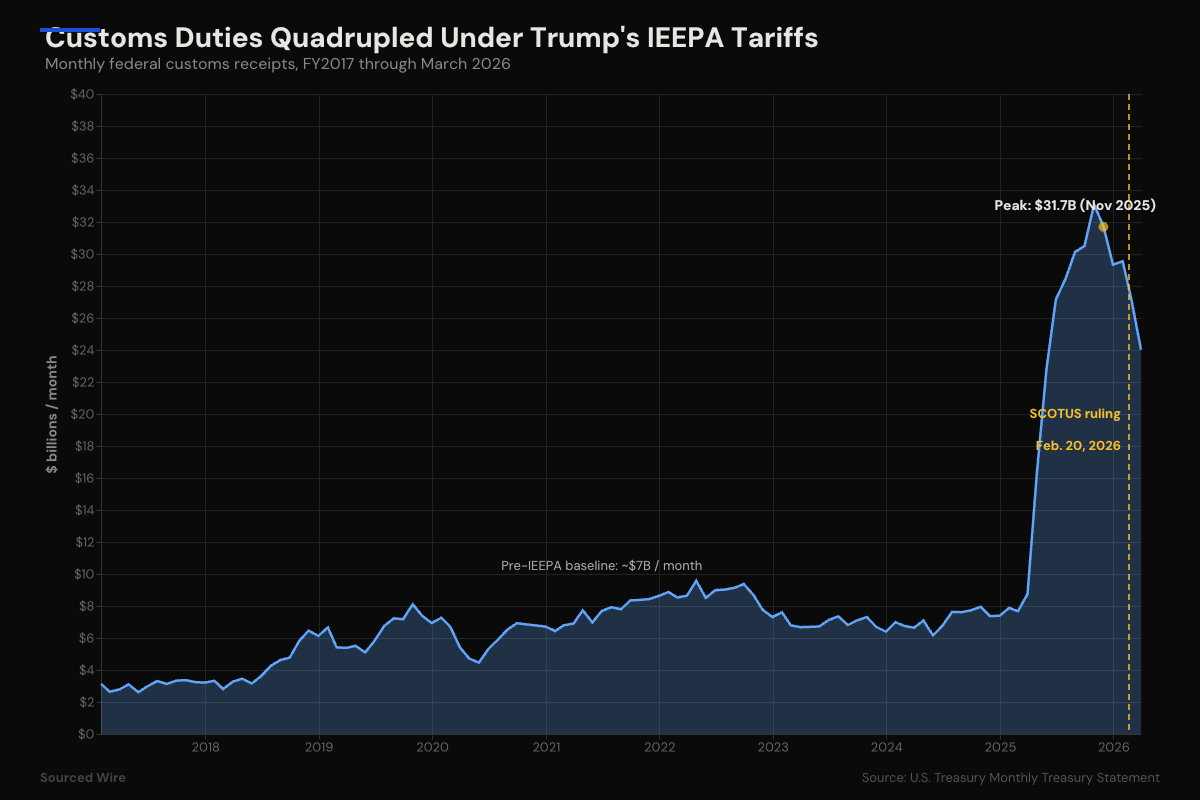
The IEEPA duties collected between the start of the Trump administration's emergency-based tariff regime and the February ruling pushed monthly customs receipts from roughly $7 billion — the pre-IEEPA baseline — to a peak of $31.7 billion in November 2025, according to the Treasury Department's Monthly Treasury Statement.
After the Supreme Court's decision, the White House terminated the IEEPA-based tariffs and announced a replacement 10 percent global tariff issued under separate statutory authorities. Customs receipts for March 2026, the most recent month reported by Treasury, totaled $24.0 billion.