FBI Director Patel sues The Atlantic for $250 million over article alleging heavy drinking
Kashyap Patel filed a 19-count defamation complaint in federal court Monday, challenging The Atlantic's April 17 account of his FBI tenure and accusing the magazine of publishing with actual malice over the FBI's on-the-record denials.
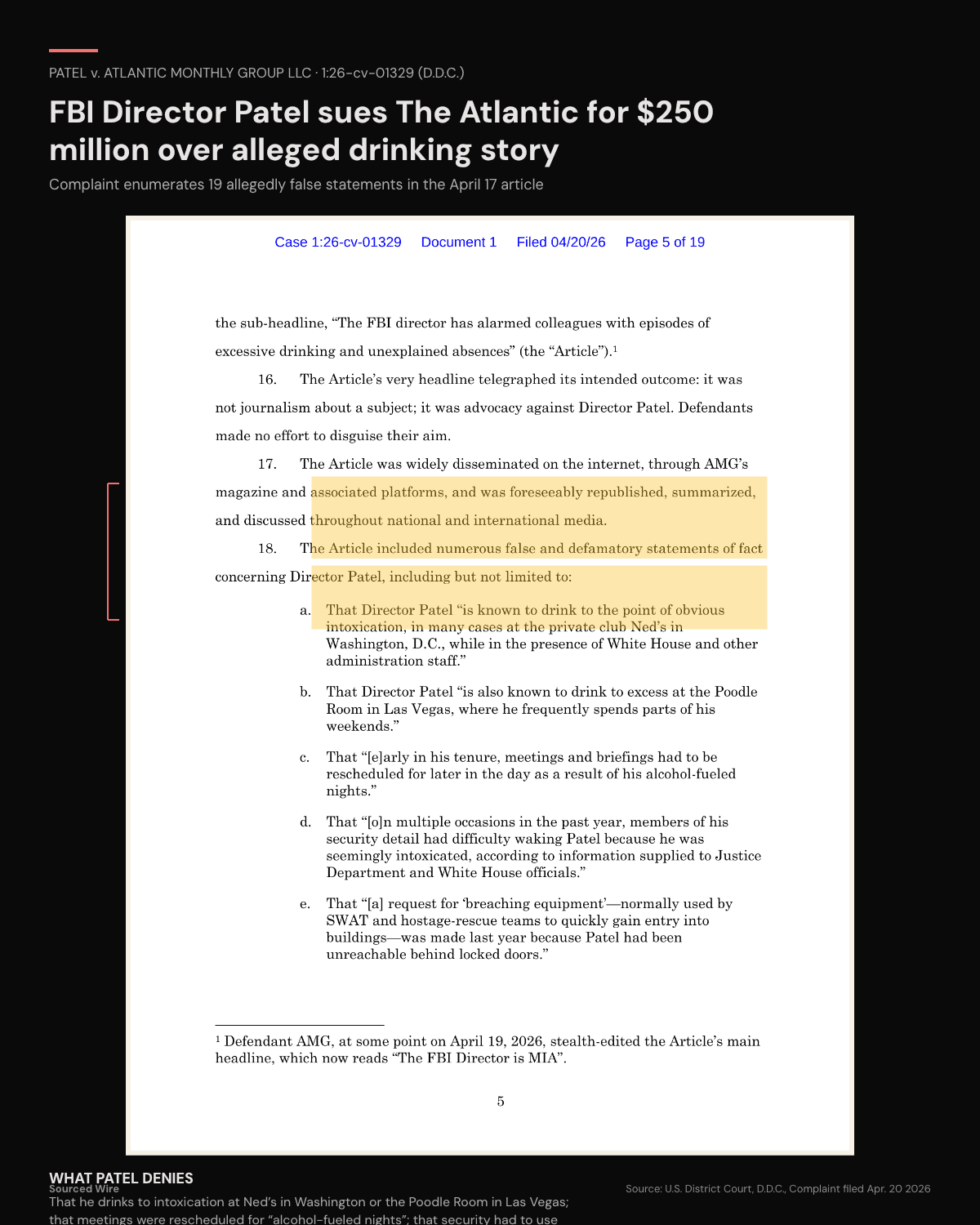
FBI Director Kashyap "Kash" Patel sued The Atlantic Monthly Group LLC and staff writer Sarah Fitzpatrick in the U.S. District Court for the District of Columbia on Monday, seeking no less than $250 million in damages over an April 17 article that alleged he drinks to intoxication, required rescue by SWAT-style breaching equipment behind locked doors, and "panicked" over losing his job.
The complaint in Patel v. Atlantic Monthly Group LLC, 1:26-cv-01329, assigned to Judge Emmet G. Sullivan, asks for compensatory, special, and punitive damages "in an amount not less than two hundred and fifty million dollars" plus disgorgement of all income the magazine earned from the story. It brings a single count of defamation and defamation per se, arguing that the statements "injure Director Patel in his profession."
The article
The Atlantic published the piece, written by Fitzpatrick, at approximately 6:20 PM EDT on April 17, 2026. The original headline was "Kash Patel's Erratic Behavior Could Cost Him His Job," with the sub-head "The FBI director has alarmed colleagues with episodes of excessive drinking and unexplained absences." Patel's complaint alleges that "at some point on April 19, 2026," the magazine "stealth-edited" the main headline to "The FBI Director is MIA."
The complaint enumerates 19 specific statements it calls false. Among them: that Patel "is known to drink to the point of obvious intoxication" at Ned's, a private club in Washington, D.C., "in many cases... in the presence of White House and other administration staff"; that he drinks "to excess at the Poodle Room in Las Vegas"; that meetings "had to be rescheduled for later in the day as a result of his alcohol-fueled nights"; that members of his security detail "had difficulty waking" him on multiple occasions; and that his security detail requested "breaching equipment" — normally used by SWAT teams — to enter a room where he had been "unreachable behind locked doors."
The article also alleged Patel's drinking impacted the Charlie Kirk murder investigation, that he complained about FBI merchandise not being "intimidating enough," and that he "panicked, frantically calling aides and allies" on April 10, 2026, to announce he believed he had been fired by the White House.
Patel's response
The FBI's Office of Public Affairs, through Assistant Director Ben Williamson, told The Atlantic before publication that the allegations were "one of the most absurd things I've ever read. Completely false at a nearly 100% clip," according to the complaint. Patel's own on-the-record statement, quoted in the article, was "Print it, all false, I'll see you in court — bring your checkbook."
The complaint cites FBI operational figures attributed to Patel's tenure: the capture of 8 of the FBI's 10 Most Wanted fugitives, more than 40,000 violent crime arrests, a 20% drop in the homicide rate, more than 2,500 kilograms of fentanyl seized, and a 43% increase in espionage arrests over 2024. It also states that Patel took 17 personal days in 2025 — fewer than predecessor Christopher Wray averaged annually over his 7.5-year tenure and a small fraction of predecessor James Comey's peak years.
White House Press Secretary Karoline Leavitt and Acting Attorney General Todd Blanche both provided on-the-record statements to The Atlantic supporting Patel. Leavitt said "crime across the country has plummeted to the lowest level in more than 100 years." Blanche said "anonymously sourced hit pieces do not constitute journalism."
Actual malice
To win a defamation case as a public official, Patel must prove "actual malice" — that The Atlantic published the statements knowing they were false or with reckless disregard for whether they were true.
The complaint focuses heavily on this element. It says The Atlantic sent the FBI a request for comment at 2:09 PM EDT on April 17 — the same day as publication — with 19 detailed allegations and a 4:00 PM EDT response deadline. Patel's counsel sent a separate pre-publication letter refuting specific claims and asking for additional response time. According to the complaint, The Atlantic did not extend the deadline or respond to the letter before publishing.
The complaint also points to a May 2025 MSNBC Morning Joe segment by former FBI official Frank Figliuzzi containing "suspiciously similar" claims that Patel had been "visible at nightclubs far more than he has been on the seventh floor of the Hoover building." MSNBC later called that a "misstatement" that had not been "verified." Patel has pending defamation litigation against MSNBC in the U.S. District Court for the Southern District of Texas over those statements.
The Atlantic's position
An Atlantic spokesperson said the magazine "stands by" its reporting and called Patel's lawsuit "meritless." Fitzpatrick told readers she interviewed more than two dozen people for the article, including current and former FBI officials, staff at law-enforcement and intelligence agencies, hospitality-industry workers, members of Congress, political operatives, lobbyists, and former advisers.
Patel is represented by Jesse R. Binnall, Jason C. Greaves, and Jared J. Roberts of the Binnall Law Group in Alexandria, Virginia. The case is brought under diversity jurisdiction; Patel is a resident of Nevada, and The Atlantic Monthly Group is headquartered in Washington, D.C.