SEC and CFTC Classify 16 Cryptocurrencies as Commodities, Not Securities
The two agencies signed a historic agreement to harmonize regulation and followed with an interpretive release naming Bitcoin, Ether, Solana, XRP, and 12 others as "digital commodities" -- ending years of jurisdictional turf wars over crypto oversight.
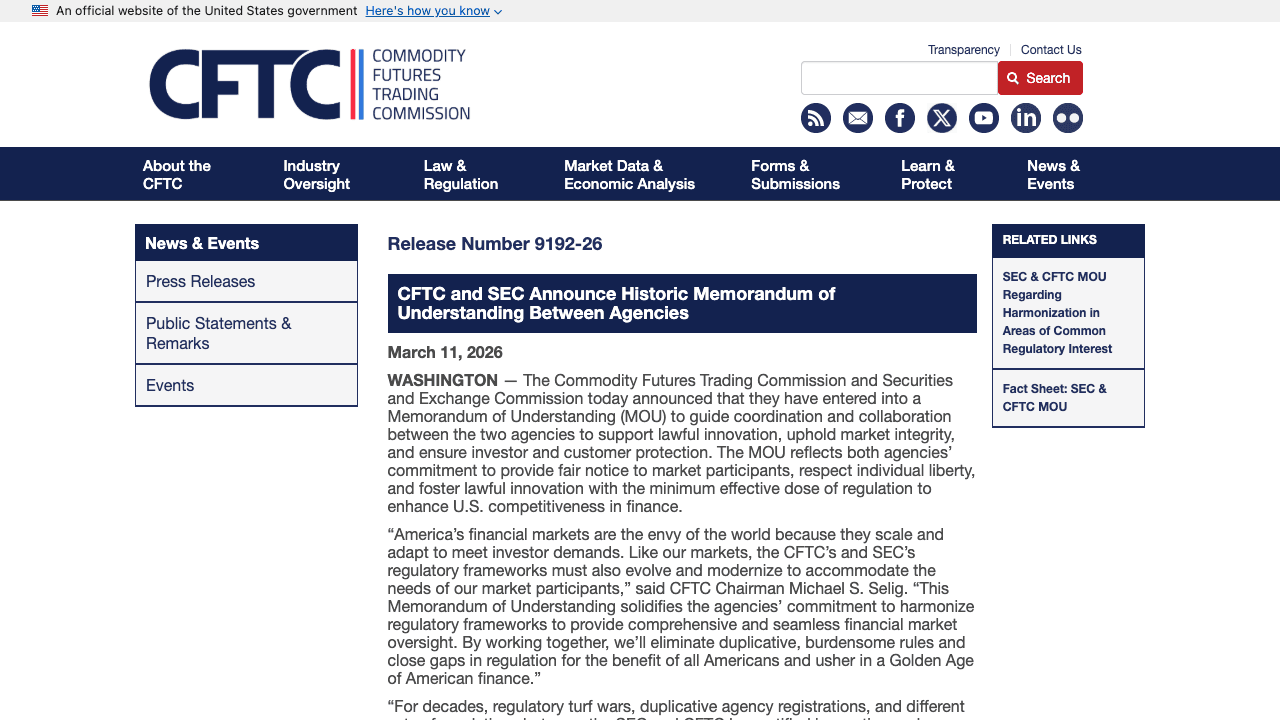
The Securities and Exchange Commission and the Commodity Futures Trading Commission signed a Memorandum of Understanding on March 11, 2026, committing to harmonize their oversight of financial markets -- and followed six days later with the SEC's most definitive crypto guidance ever issued: an interpretive release classifying 16 major cryptocurrencies as "digital commodities," not securities.
The designation means these assets fall primarily under the CFTC's jurisdiction as commodities, not the SEC's as securities -- a distinction the industry has fought over for years.
The 16 Digital Commodities
The SEC's Interpretive Release (No. 33-11412, March 17, 2026) named the following tokens:
| Token | Ticker |
|---|---|
| Bitcoin | BTC |
| Ether | ETH |
| Solana | SOL |
| XRP | XRP |
| Dogecoin | DOGE |
| Cardano | ADA |
| Avalanche | AVAX |
| Chainlink | LINK |
| Polkadot | DOT |
| Hedera | HBAR |
| Litecoin | LTC |
| Bitcoin Cash | BCH |
| Shiba Inu | SHIB |
| Stellar | XLM |
The classification defines digital commodities as "crypto assets deriving value from the programmatic operation of a functional crypto system and supply-and-demand dynamics rather than from an expectation of profits." The key criteria: the underlying system must be decentralized, without a central party controlling it.
The Five-Category Taxonomy
Beyond the 16 named tokens, the SEC established a framework for all crypto assets:
Digital commodities -- decentralized tokens valued by supply and demand, not profit expectations. Not securities.
Digital collectibles -- NFTs and similar assets tied to art, gaming, or culture. Not securities, though fractionalization may raise securities concerns.
Digital tools -- utility tokens for memberships, credentials, or identity. Often non-transferable. Not securities.
Stablecoins -- assets pegged to the dollar and backed by liquid reserves. "Covered stablecoins" under the GENIUS Act are excluded from the securities definition.
Digital securities -- traditional financial instruments represented on-chain. These remain fully subject to securities law regardless of format.
The MOU: Six Areas of Harmonization
The underlying agreement commits both agencies to coordinate across six areas:
- Product definitions -- joint interpretations clarifying which agency has jurisdiction over specific products
- Clearing and margin -- modernizing frameworks that currently differ between agencies
- Dually registered entities -- reducing friction for firms registered with both the SEC and CFTC
- Digital asset framework -- the "fit-for-purpose" regulatory approach for crypto and emerging technologies
- Regulatory reporting -- streamlining overlapping data and disclosure requirements
- Enforcement coordination -- ending duplicative enforcement actions for the same conduct
SEC Chairman Paul Atkins framed the shift in a speech the day before the signing: "The regrettable era of duplicative enforcement actions and conflicting remedial obligations for the same conduct is over."
CFTC Chairman Michael Selig called the MOU a commitment to "harmonize regulatory frameworks to provide comprehensive oversight."
Crypto exchanges gain the most immediate clarity. Platforms listing the 16 named tokens no longer face the threat of SEC enforcement for trading unregistered securities -- the primary legal risk that has driven exchanges offshore or limited U.S. token offerings.
Token issuers now have a taxonomy to assess whether their project falls under commodity, collectible, tool, or security classification. The "investment contract separation" doctrine means tokens can start as securities and later "separate" from that status once purchasers no longer rely on issuer efforts for returns.
Dually registered firms will benefit from coordinated examination cycles and shared supervisory insights, rather than navigating two independent regulatory regimes with overlapping demands.
Retail investors face fewer restrictions on accessing tokens classified as commodities, since commodity markets carry different registration and disclosure requirements than securities markets.
What's Next
The agencies envision regulated "super-apps" -- unified financial platforms where users access securities, derivatives, crypto, and banking services under a single coordinated framework. Atkins said that "where one agency's framework achieves comparable regulatory outcomes, then it should be capable of satisfying overlapping requirements of the other."
The MOU aligns with the CLARITY Act, a digital asset market structure bill that passed the House in July 2025 and cleared the Senate Agriculture Committee in January 2026 but has not yet been signed into law. If enacted, it would codify the commodity-vs-security classification into statute.
A Joint Harmonization Initiative, co-led by Meghan Tente of the CFTC and Robert Teply of the SEC, is accepting public input through the agencies' harmonization websites.
Background
For years, the SEC and CFTC fought publicly over crypto jurisdiction. The SEC under former Chairman Gary Gensler pursued an aggressive "regulation by enforcement" strategy, suing exchanges and token issuers for trading unregistered securities -- without providing clear rules for what counted as a security. The CFTC, meanwhile, claimed authority over crypto derivatives and spot commodities. Market participants were caught between the two.
The shift began in January 2026 when Atkins and Selig announced "Project Crypto" at a joint event at CFTC headquarters -- the first formal inter-agency initiative to coordinate crypto oversight. Selig announced the CFTC would fold its separate "Crypto Sprint" initiative into the SEC's Project Crypto, "bringing coordination, coherence, and a unified approach to the federal oversight of crypto asset markets."