U.S. Import Prices Post Fastest Annual Rise Since Early 2025 as Export Costs Surge 5.6%
The cost of traded goods accelerated sharply on both sides in March, with import prices climbing 2.1% year-over-year and export prices surging 5.6% -- their fastest pace in years -- as tariff-era trade dynamics reshape pricing across the global supply chain.
U.S. import prices rose 0.8 percent in March and 2.1 percent over the past year, the Bureau of Labor Statistics reported Tuesday -- the fastest annual pace since early 2025, capping a quarter in which trade costs accelerated sharply after a year of near-zero growth.
Export prices climbed even faster: up 1.6 percent for the month and 5.6 percent year-over-year, making American goods increasingly expensive for foreign buyers.
The Q1 acceleration
The import price index was essentially flat through all of 2025 -- starting the year at 141.8 and ending at 141.4. Then it jumped 2.3 percent in the first quarter of 2026 alone.
| Month | Import prices (MoM) | Export prices (MoM) |
|---|---|---|
| January 2026 | +0.6% | +0.5% |
| February 2026 | +0.9% | +1.9% |
| March 2026 | +0.8% | +1.6% |
The acceleration coincides with the implementation of new tariff regimes, though the BLS import price index measures prices at the port of entry before customs duties are applied. The actual cost to U.S. importers -- price plus tariff -- is higher than what the index captures.
Stripping out petroleum
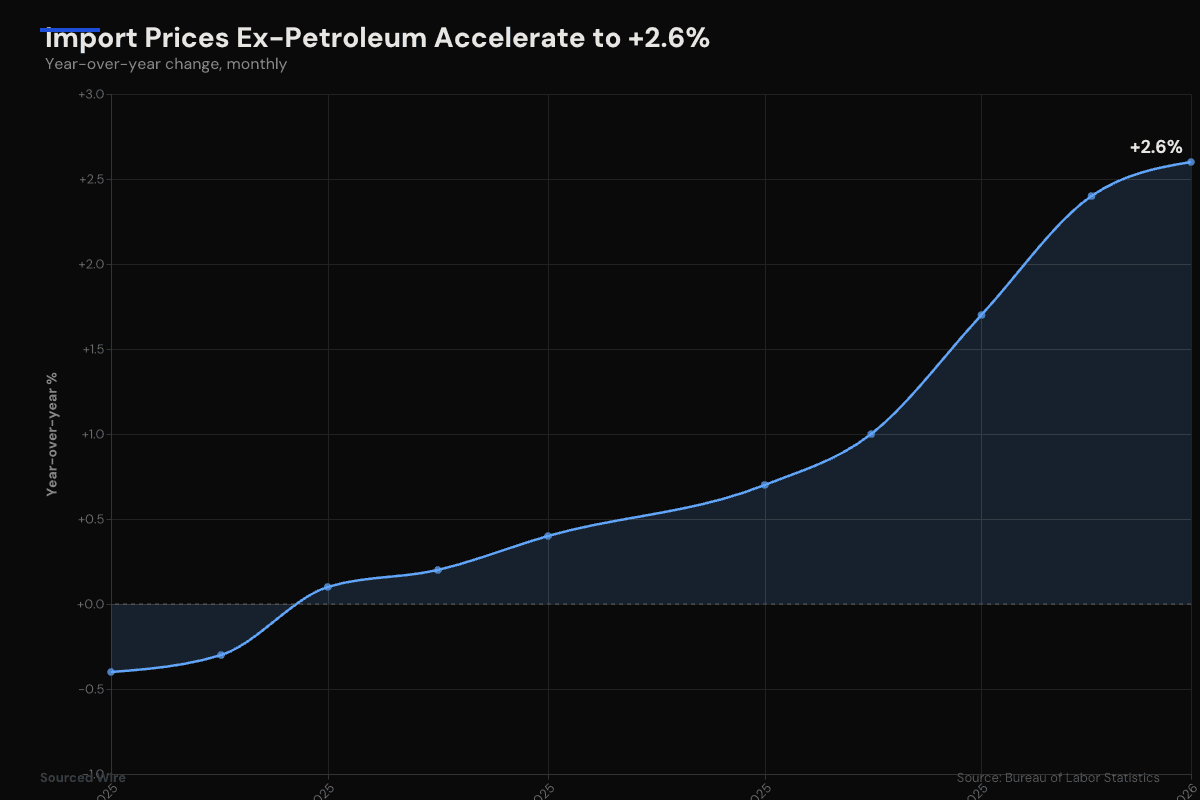
Imports excluding petroleum rose 2.6 percent year-over-year in March, up from just 0.7 percent in November -- a cleaner signal of tariff-related price pressure since it removes oil price volatility.
| Period | Imports ex-petroleum (YoY) |
|---|---|
| November 2025 | +0.7% |
| December 2025 | +1.0% |
| January 2026 | +1.7% |
| February 2026 | +2.4% |
| March 2026 | +2.6% |
Five straight months of acceleration.
China prices are falling
Prices for goods imported from China fell 1.1 percent year-over-year in March -- continuing a decline that has persisted for over a year. Chinese exporters appear to be cutting dollar prices to maintain market share despite steep tariffs, effectively absorbing part of the tariff cost.
But this isn't reducing the overall import bill. As U.S. buyers shift to non-China sources -- Vietnam, India, Mexico, the EU -- they're paying more for goods that China had been supplying at lower prices. The BLS data suggests trade diversion is a net cost: alternative suppliers charge more than the Chinese exporters they're replacing.
What it means for consumers
Import prices feed into consumer prices with a lag. The 2.6 percent rise in non-petroleum imports -- goods like electronics, machinery, consumer products, and industrial materials -- will eventually show up in the CPI as retailers and manufacturers pass costs through.
The export side carries its own risk. At 5.6 percent annual growth, U.S. goods are pricing themselves out of foreign markets. American manufacturers competing globally face a double squeeze: higher input costs from more expensive imports and lower demand from more expensive exports.