NASA's SPHEREx Maps 'Interstellar Glaciers' Spanning 600 Light-Years in the Milky Way
NASA's newest space telescope has produced the first large-scale map of interstellar ice in the Cygnus X star-forming region, revealing vast frozen complexes of water, carbon dioxide, and carbon monoxide that could seed future solar systems with the raw materials for life.
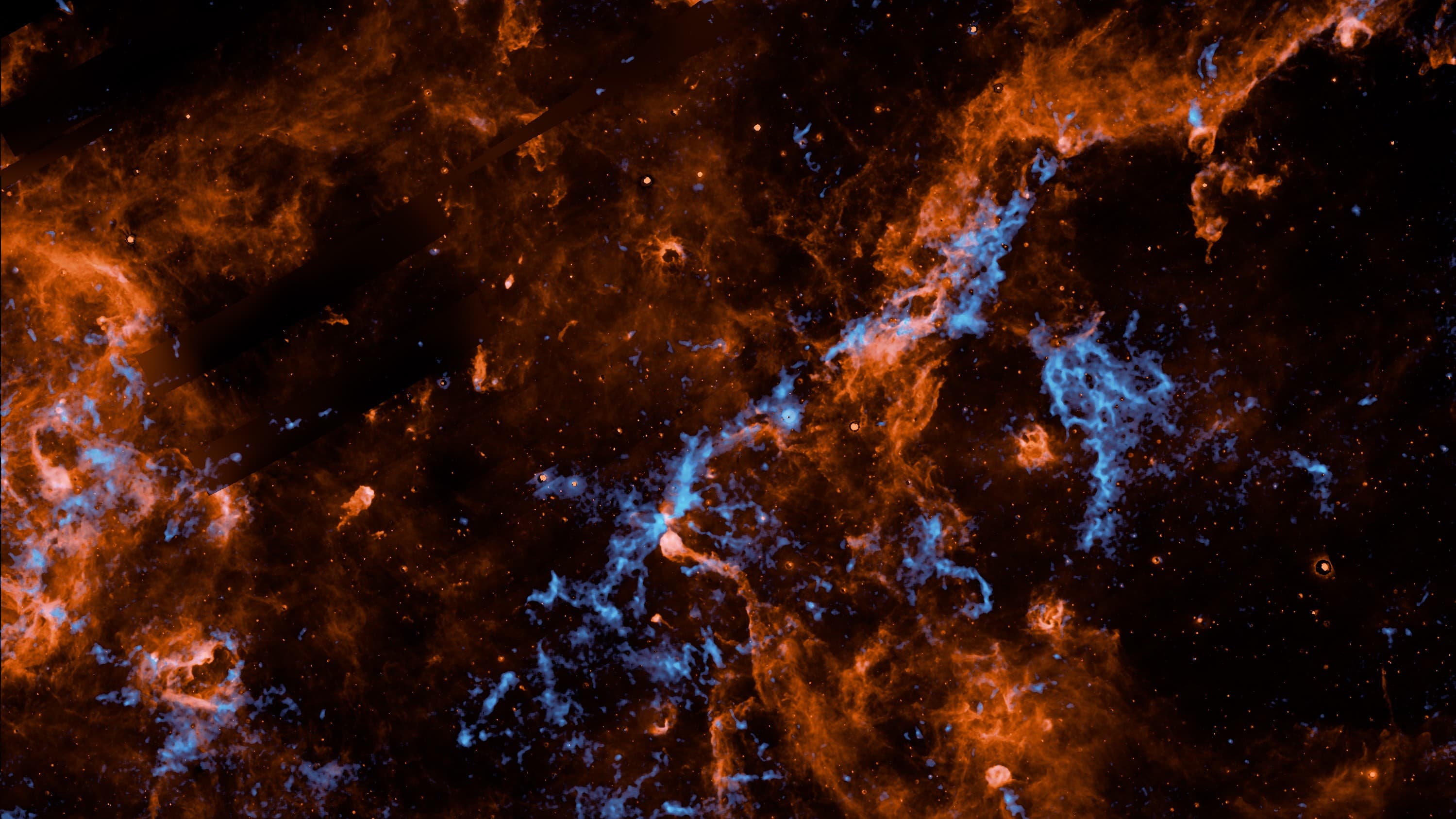
NASA's SPHEREx telescope has produced the first large-scale map of interstellar ice, revealing "interstellar glaciers" stretching across more than 600 light-years in one of the Milky Way's most active stellar nurseries. The findings, published today in The Astrophysical Journal, show where the universe stores the water, carbon dioxide, and carbon monoxide that will eventually end up on planets.
"These vast frozen complexes are like 'interstellar glaciers' that could deliver a massive water supply to new solar systems that will be born in the region," said Phil Korngut, SPHEREx instrument scientist at Caltech. "It's a profound idea that we are looking at a map of material that could rain on nascent planets and potentially support future life."
What SPHEREx sees
The telescope observed the Cygnus X star-forming region -- one of the Milky Way's most turbulent zones of stellar birth -- in 102 infrared color bands, picking up the chemical fingerprints of three types of ice: water (H2O), carbon dioxide (CO2), and carbon monoxide (CO). The resulting map shows water ice as bright blue filaments threading through dark lanes of interstellar dust.
The ice forms on the surfaces of tiny dust grains no larger than particles of candle smoke. In the cold, dense interiors of giant molecular clouds -- where temperatures hover around minus 440 degrees Fahrenheit -- gas molecules freeze onto these grains, building up layers of ice over millions of years.
"When looking along the galactic plane -- where most of the stars, gas, and dust are concentrated -- there's diffuse background light shining through entire dust clouds, and SPHEREx can see the spatial distribution of the ices they contain in incredible detail," said Joseph Hora, the study's lead author at the Harvard & Smithsonian Center for Astrophysics.
Why it matters
The ice SPHEREx mapped is not a curiosity. It is the source of water throughout the universe. Earth's oceans, the ices on comets and moons, the frozen poles of Mars -- all trace back to reservoirs like these, formed in molecular clouds billions of years ago and delivered to rocky planets during solar system formation.
Mapping where ice exists and how its abundance varies across different environments helps answer a fundamental question: what determines whether a forming planetary system gets enough water to support life? SPHEREx's large-scale survey can now measure how environmental factors -- particularly ultraviolet radiation from nearby massive young stars -- affect how much ice survives in different parts of a star-forming region.
The mission
SPHEREx (Spectro-Photometer for the History of the Universe, Epoch of Reionization, and Ices Explorer) launched on March 11, 2025, and completed the first of four planned all-sky infrared maps by late 2025, charting hundreds of millions of galaxies in three dimensions. Mapping interstellar ice is one of its three core science goals, alongside surveying the large-scale structure of the universe and studying the physics of the Big Bang.
The ice investigation will continue as SPHEREx completes its remaining sky surveys, building a progressively more detailed chemical atlas of where the building blocks of life are stored across the galaxy.