Pentagon Inspector General Bars 'Department of War' Title From Court Filings, Subpoenas, and Criminal Investigations
An April 1 memo from the DoD Office of Inspector General lists the places where the Trump-ordered 'Department of War' rebrand does not apply. They are the places where the name carries legal weight.
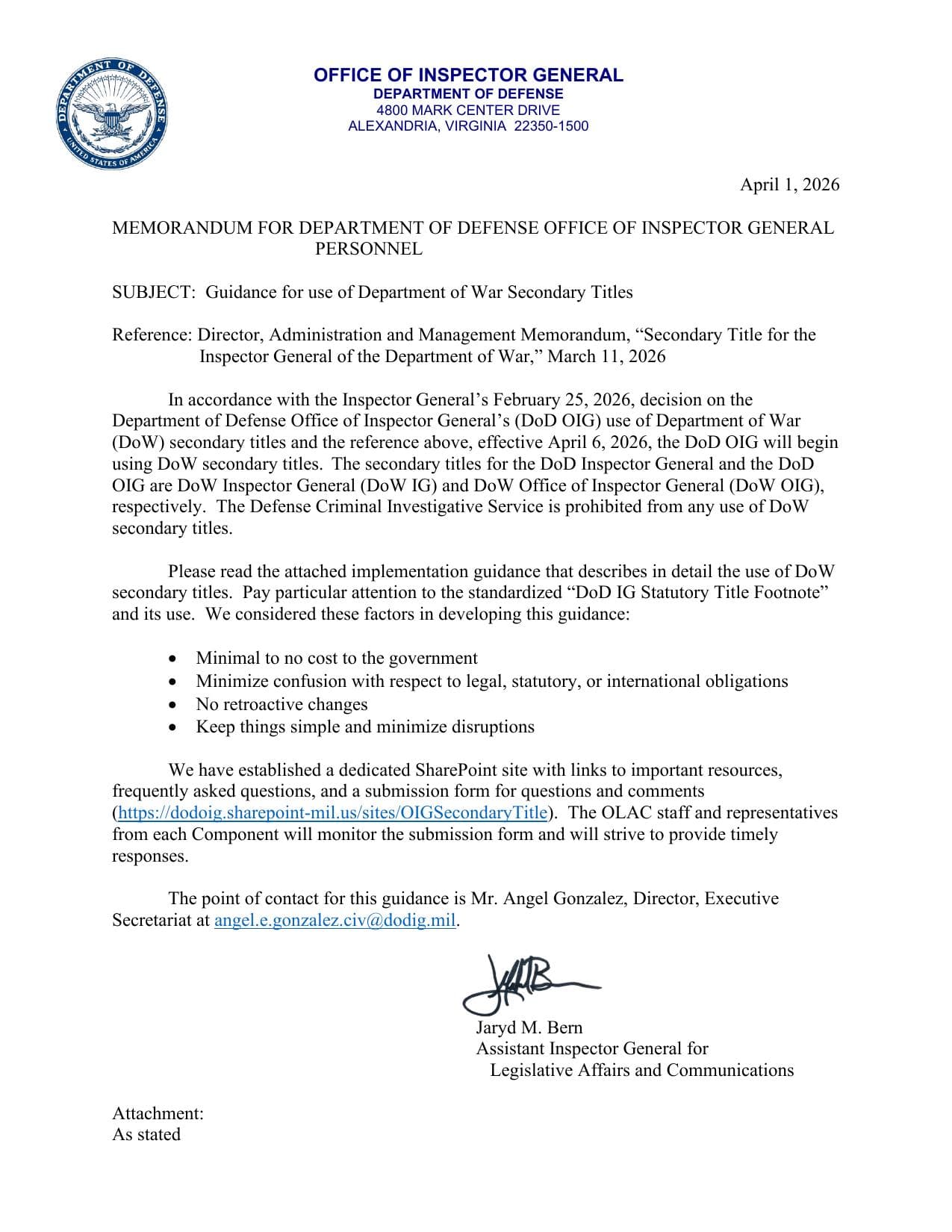
Seven months after President Trump signed an executive order authorizing 'Department of War' as a secondary title for the Pentagon, the department's own Inspector General has published a formal list of the places where the rebrand does not apply.
The April 1, 2026 memo, signed by Assistant Inspector General for Legislative Affairs and Communications Jaryd M. Bern, directs the DoD Office of Inspector General to begin using 'Department of War' secondary titles on websites, social media, letterhead, PowerPoint templates, email signatures, report covers, and Microsoft Teams backgrounds starting April 6. It also spells out, in a table labeled 'Exempt From Use,' every place the titles cannot be used.
The exempt list includes subpoenas, court filings, memoranda of understanding with organizations outside the department, the DoD Hotline, all existing office and suite signage, credentials, the agency's IT systems, and its dodig.mil domain. The Defense Criminal Investigative Service, the Pentagon's lead federal criminal investigators of fraud, bribery, and procurement crime, is 'prohibited from any use' of Department of War titles.
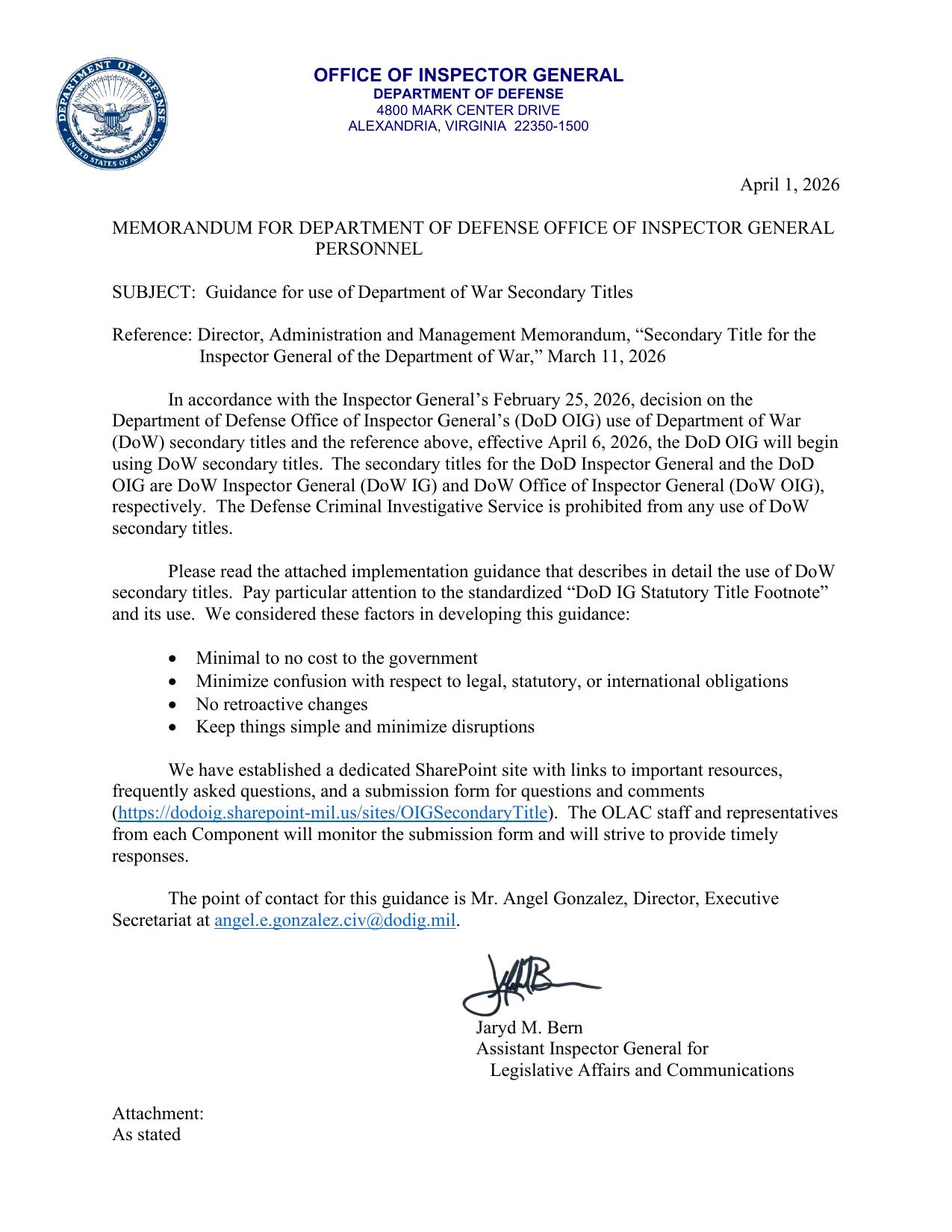
The memo also mandates that every document using 'Department of War' must carry a standardized footnote clarifying that 'the use of these secondary titles does not in any way affect the primary statutory title or authorities of the DoD IG under The Inspector General Act of 1978, as amended (5 U.S.C. Chapter 4, Inspectors General), or the authorities or responsibilities of the DoD IG or DoD OIG pursuant to any laws, regulations, or policies.'
What the executive order did, and did not, do
President Trump signed Executive Order 14347, 'Restoring the United States Department of War,' on September 5, 2025. The order authorizes Defense Secretary Pete Hegseth to use 'Secretary of War' as an 'additional secondary title' in 'official correspondence, public communications, ceremonial contexts, and non-statutory documents within the executive branch.'
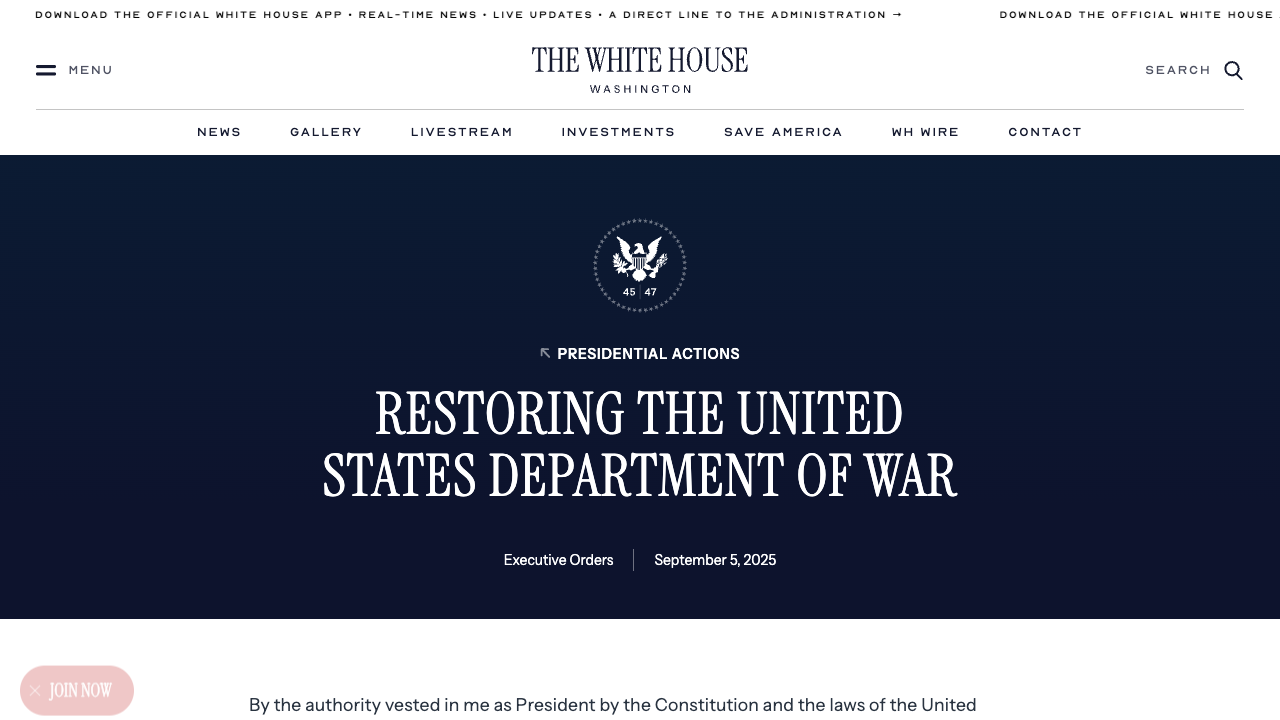
Section 2(e) of the order concedes its own limits: 'Statutory references to the Department of Defense, Secretary of Defense, and subordinate officers and components shall remain controlling until changed subsequently by the law.'
Section 2(g) directed Hegseth to submit a recommendation, within 60 days, on the 'legislative and executive actions necessary' to permanently rename the department. That deadline passed in early November 2025.
Shortly after the order was signed, the Defense Department rebranded its website to war.gov, Hegseth began signing general-officer announcements as 'Secretary of War,' and the Pentagon's river entrance received new 'Department of War' signage that Hegseth installed personally. The department's legal name has not changed.
The bill to make it legally binding has not moved
To actually rename the department, Congress must pass legislation. On September 16, 2025, eleven days after Trump's executive order, Representative Tim Burchett (R-TN) introduced H.R. 5389, the 'Restoring the United States Department of War Act.'
Seven months later, the bill has zero cosponsors. Its only recorded action is its introduction and referral to the House Committee on Armed Services on the day it was filed. It has not been marked up, reported out of committee, scheduled for floor consideration, or picked up by a Senate counterpart.
What the IG memo exempts, and why
The exemptions in the Inspector General guidance track the places where the name carries legal, statutory, or contractual weight.
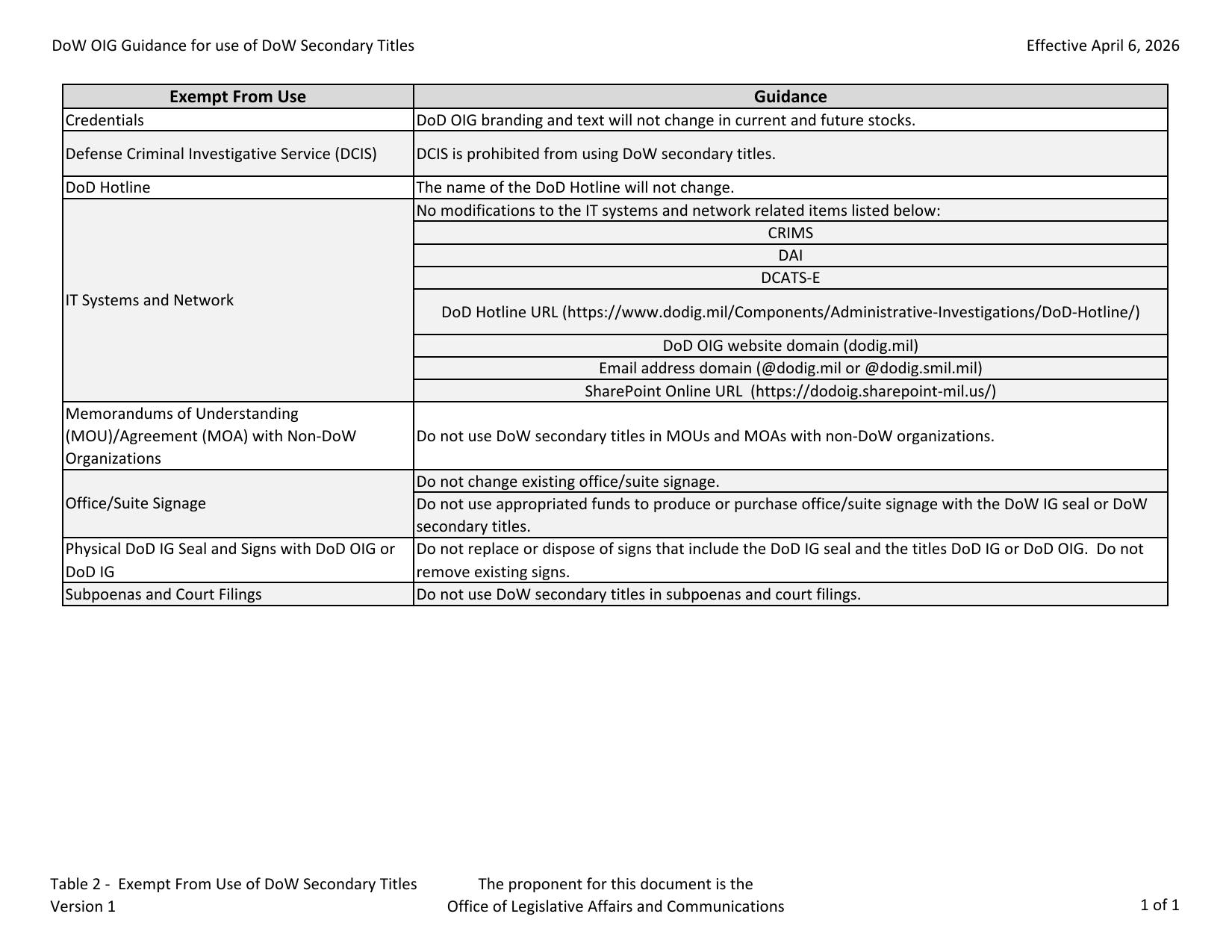
The restrictions, taken from the memo's implementation guidance, include:
- Subpoenas and court filings: 'Do not use DoW secondary titles in subpoenas and court filings.'
- Defense Criminal Investigative Service: 'DCIS is prohibited from using DoW secondary titles.' DCIS is the lead federal agency for investigating fraud, bribery, public corruption, and procurement crime affecting the department.
- Memoranda of understanding with non-DoW organizations: 'Do not use DoW secondary titles in MOUs and MOAs with non-DoW organizations.'
- DoD Hotline: 'The name of the DoD Hotline will not change.' The hotline is the statutory public channel for reporting waste, fraud, and abuse.
- IT systems and network: No changes to CRIMS, DAI, DCATS-E, the DoD Hotline URL, the dodig.mil website domain, the @dodig.mil email domain, or the SharePoint Online URL.
- Office and suite signage: 'Do not change existing office/suite signage. Do not use appropriated funds to produce or purchase office/suite signage with the DoW IG seal or DoW secondary titles.'
- Physical DoD IG seals and signs: 'Do not replace or dispose of signs that include the DoD IG seal and the titles DoD IG or DoD OIG. Do not remove existing signs.'
- Credentials: 'DoD OIG branding and text will not change in current and future stocks.'
- DCIS forms: 'Do not use DoW secondary titles in DCIS forms.'
The memo says the guidance was developed with four goals: 'minimal to no cost to the government,' 'minimize confusion with respect to legal, statutory, or international obligations,' 'no retroactive changes,' and 'keep things simple and minimize disruptions.'
The running cost
The Congressional Budget Office has estimated the rebrand will cost between $10 million and $125 million in its current form as a secondary title, and could rise to hundreds of millions if Congress passes H.R. 5389 and the name becomes legally binding across all statutory references, forms, and records. NBC News reported in November 2025 that internal Pentagon estimates for full implementation ran as high as $2 billion, with roughly half of that for letterhead and signage.
For the Office of Inspector General, the April 1 memo instructs staff not to dispose of existing stocks of posters, brochures, and business cards, and to 'use existing stocks until depleted and then produce or purchase more materials.'