ICE Shot a Man It Called a Gang Member Wanted for Murder. Court Documents Show He Was Acquitted.
ICE agents shot Carlos Ivan Mendoza Hernandez in a California traffic stop, claiming he was an 18th Street gang member who tried to run them over. His attorney has El Salvador court documents showing he was acquitted of the murder charge, and says he was driving to work.
ICE agents shot and critically wounded a man during a traffic stop near Interstate 5 in Patterson, California on April 7, claiming he was an 18th Street gang member wanted in El Salvador for murder who "weaponized his vehicle" against officers. His attorney has produced El Salvador court documents showing the man was acquitted of that murder charge in 2019, says he has no gang affiliation, and was driving to his construction job when agents opened fire.
The shooting is the latest in a series of ICE use-of-force incidents where the agency's initial account has been challenged by video or documentary evidence. In January, Minneapolis released body camera footage that contradicted ICE agents' sworn testimony in a separate shooting.
ICE's account
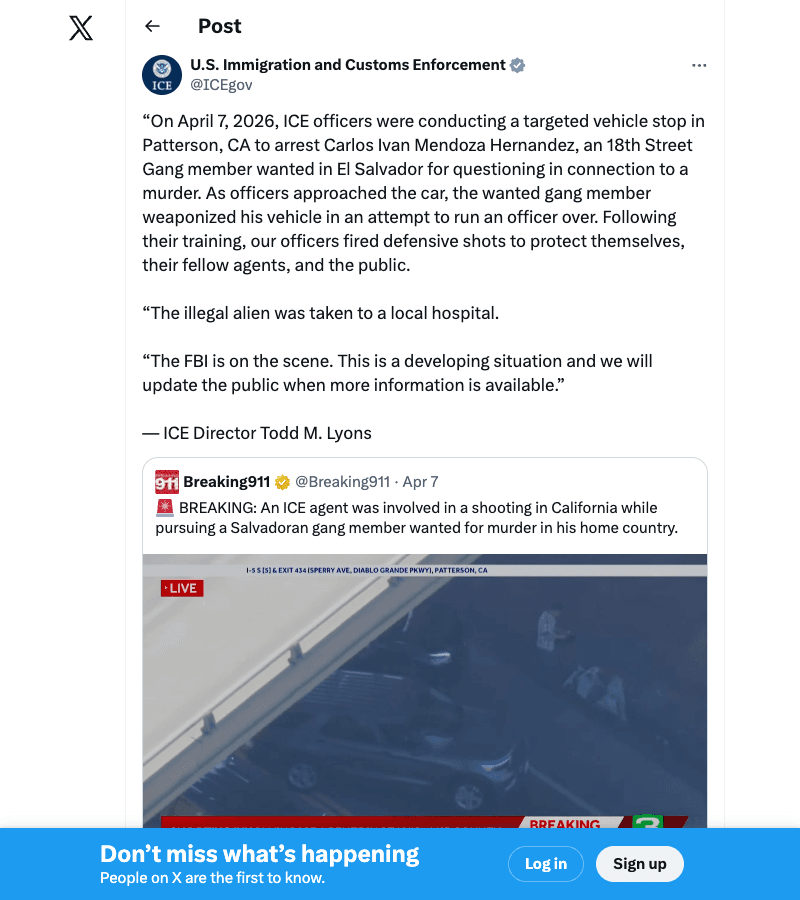
Acting ICE Director Todd Lyons posted a statement on the agency's official X account hours after the shooting:
"On April 7, 2026, ICE officers were conducting a targeted vehicle stop in Patterson, CA to arrest Carlos Ivan Mendoza Hernandez, an 18th Street Gang member wanted in El Salvador for questioning in connection to a murder. As officers approached the car, the wanted gang member weaponized his vehicle in an attempt to run an officer over. Following their training, our officers fired defensive shots to protect themselves, their fellow agents, and the public."
The Stanislaus County Sheriff's Office confirmed a federal officer-involved shooting in Patterson but said no local law enforcement was involved. The FBI assumed primary responsibility for the investigation.
The evidence
Attorney Patrick Kolasinski, representing Mendoza Hernandez and his family, held a press conference the following day and presented documents that contradict ICE's claims on multiple points.
On the murder charge: Kolasinski produced an El Salvador court document dated October 25, 2019, showing Mendoza Hernandez was tried and acquitted of murder. He was ordered immediately released. "There could not possibly be a warrant out for his arrest" in El Salvador, Kolasinski said.
On gang membership: "He was never in a gang," Kolasinski told reporters. Mendoza Hernandez, 36, works in fire rehabilitation construction, is engaged to a U.S. citizen, and has a two-year-old daughter. His only contact with U.S. law enforcement was a traffic ticket and a stop for a cracked windshield.
On the vehicle: Kolasinski disputed that Mendoza Hernandez tried to run over officers. "It was natural for him to try to flee" from agents, the attorney said, framing the vehicle movement as an attempt to escape rather than an attack. He argued that "ICE's own training puts the community in danger."
What the dashcam shows
Dashcam footage obtained by KTVU from a passing driver captured the moments before and during the shooting. The silent video shows:
- Three officers standing around a stopped vehicle on the side of the road
- One officer at the driver-side window
- The car begins to back up and turn
- The officer at the window draws a weapon and fires as the car moves
- The vehicle then pulls forward and turns sharply, driving over the roadway median
The sequence raises a question central to the case: did officers fire because the vehicle was coming toward them, or did the vehicle lurch forward because the driver had already been shot?
No access to the hospital
Mendoza Hernandez's fiancee, identified only as Cindy, said hospital staff in Modesto told her they were "not authorized" to provide information about his condition. Neither she nor Kolasinski have been able to see or speak to him since the shooting. Kolasinski believes his client is in FBI custody.
A pattern
The Patterson shooting follows a pattern of ICE use-of-force incidents in 2026 where the agency's initial narrative has been contradicted by independent evidence:
- Minneapolis, January 7: DHS initially claimed a man rammed agents with his vehicle. Body camera footage released in March showed the vehicle turning away from agents when they opened fire.
- Patterson, April 7: ICE claimed a gang member wanted for murder weaponized his vehicle. Court documents show acquittal; dashcam footage shows the car backing away before shots were fired.
In both cases, ICE described the suspect as a dangerous criminal who attacked officers with a vehicle. In both cases, subsequent evidence complicated that account.
The FBI investigation is ongoing. Mendoza Hernandez has not been formally charged with any crime in the United States.