Uganda Receives First US Deportation Flight: Eight Non-Citizens Sent to a Country They Have No Ties To
Eight African nationals, none of them Ugandan citizens, arrived at Entebbe airport on April 1 aboard a private charter -- the first transfer under an agreement that allows the US to send denied asylum seekers to countries they have no connection to.
Eight people deported from the United States arrived at Entebbe International Airport on April 1 aboard a private charter flight, the first transfer under a bilateral agreement that allows the US to send non-citizens to countries where they have no ties.
The deportees are all African nationals, but none are Ugandan citizens. Their identities have not been disclosed. Uganda's Permanent Secretary for Foreign Affairs, Bagiire Vincent Waiswa, confirmed the arrival on April 3, saying Uganda accepted them as a "safe third country" where their protection claims will be reassessed.
The Uganda Law Society initially said 12 deportees were scheduled on the flight. The Foreign Ministry's official count was eight.
The Agreement
The transfer was carried out under the Agreement for Cooperation in the Examination of Protection Requests, signed by the two governments on July 29, 2025. Under its terms, the US can send individuals who have been denied asylum but who face risks if returned to their home countries to Uganda, which then conducts its own refugee status determination.
Uganda is one of several countries the Trump administration has signed third-country removal agreements with. Similar arrangements exist with Honduras and Ecuador, and Washington has pursued additional deals with Eswatini, Ghana, Rwanda, and South Sudan.
Legal Battles on Two Continents
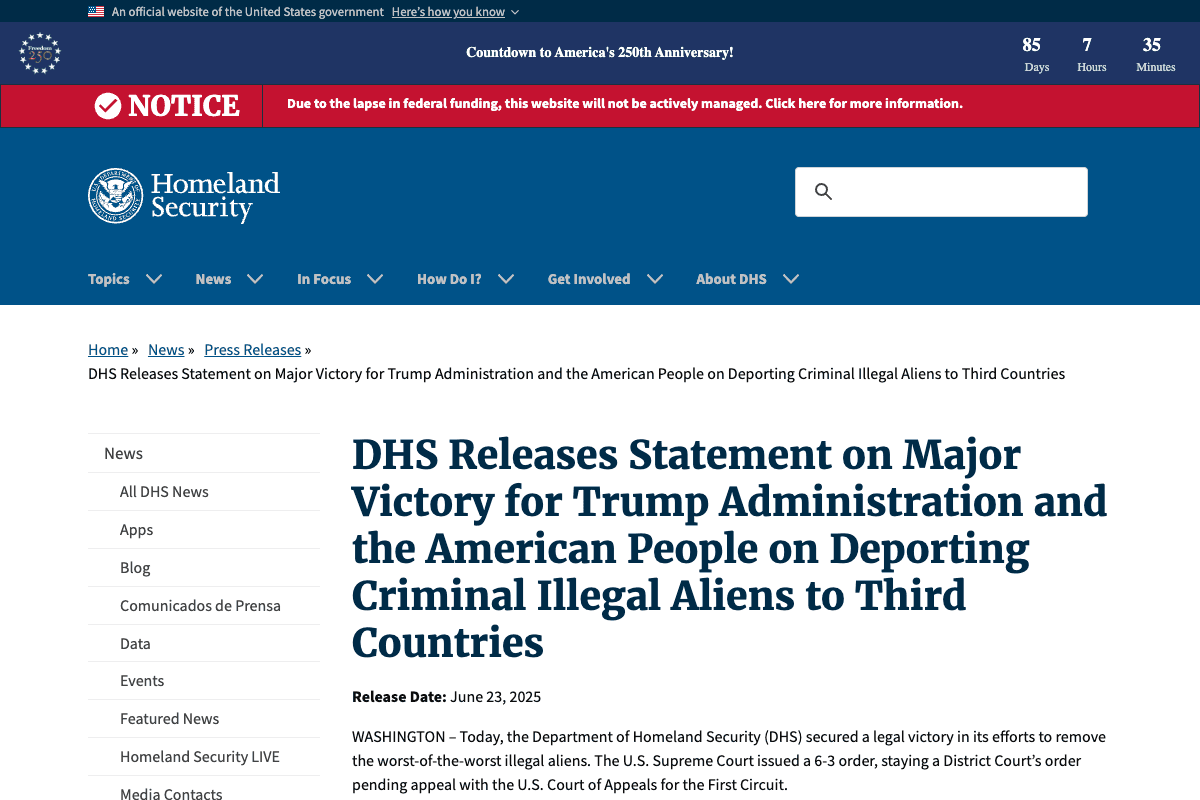
The program cleared a major US legal hurdle on June 23, 2025, when the Supreme Court stayed a preliminary injunction in D.V.D. v. DHS in a 6-3 order issued without explanation. The district court had required the government to provide written notice of the destination country, a meaningful opportunity to raise fear of torture, and at least 10 days before removal. Justice Sotomayor, dissenting, called the stay a "gross abuse" of equitable discretion.
In Uganda, the legal response was immediate. The Uganda Law Society and the East Africa Law Society filed court challenges within days, calling the process "undignified, harrowing, and dehumanising." They argue that no Ugandan state institutions -- the Directorate of Citizenship and Immigration Control, Parliament, or the Ministry of Foreign Affairs -- were properly engaged before the flight landed, and that no domestic legislation governs the transfer of people between countries.
What the Agreement Does and Doesn't Say
The Department of Homeland Security has framed its third-country removal authority as a tool for deporting "criminal illegal aliens" when their home countries refuse to accept them. The agreement's actual scope is broader: it covers any individual denied asylum in the US who faces danger at home, regardless of criminal history.
The eight people now in Uganda will undergo refugee status determination under Ugandan law. The legal challenges in both countries remain active. The underlying merits of D.V.D. v. DHS have not been resolved.