US Measles Cases Hit 1,714 in First 100 Days of 2026, Threatening Elimination Status
The US has recorded 1,714 confirmed measles cases across 33 states in just the first 100 days of 2026, on pace to exceed last year's 2,287 total. Kindergarten vaccination coverage has dropped below the 95% herd immunity threshold for the first time.
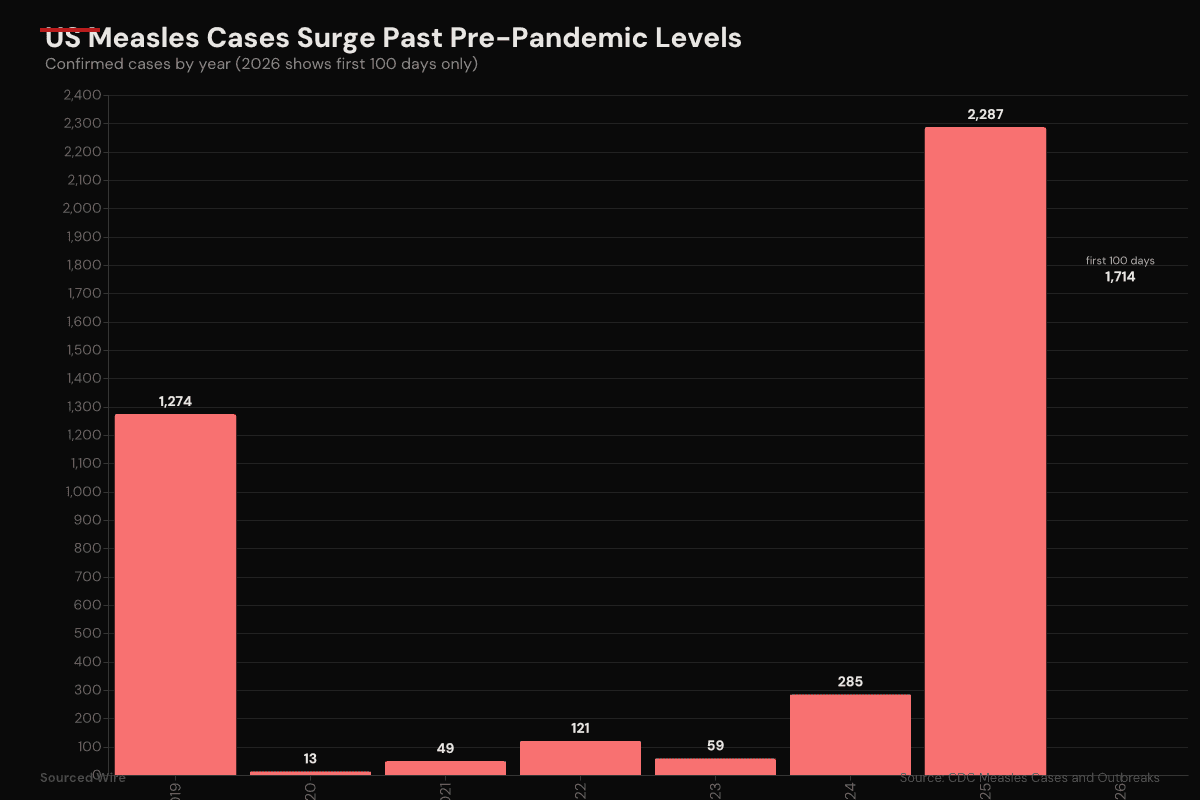
The United States has recorded 1,714 confirmed measles cases in the first 100 days of 2026, according to CDC data updated April 10. At this pace, the country will exceed 2025's total of 2,287 cases -- itself the highest since 1992.
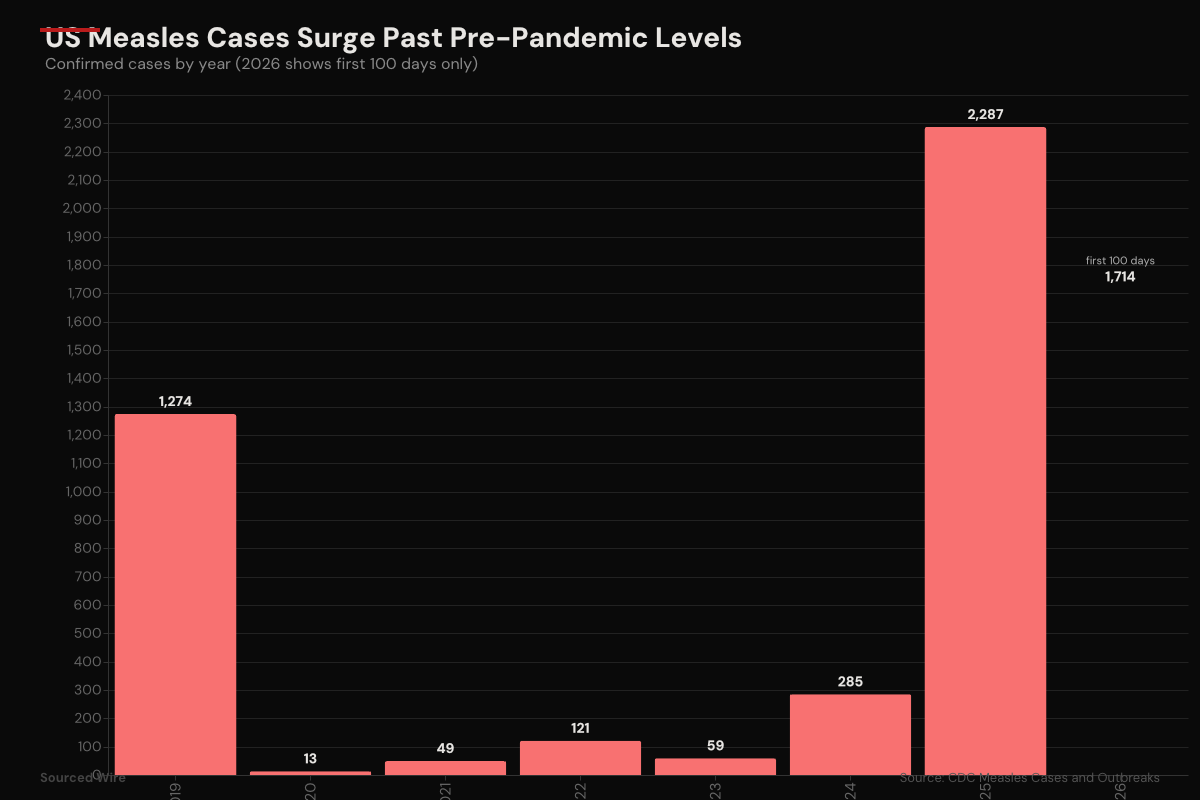
The trajectory: 59 cases in 2023. Then 285 in 2024. Then 2,287 in 2025. Now 1,714 in a quarter of the time. Measles was eliminated from the United States in 2000. That status -- defined as the absence of endemic transmission for 12 or more continuous months -- is now at risk.
The numbers
| 2023 | 2024 | 2025 | 2026 (100 days) | |
|---|---|---|---|---|
| Confirmed cases | 59 | 285 | 2,287 | 1,714 |
| Outbreaks | -- | 16 | 48 | 17 |
| States reporting | -- | -- | 45 | 33 |
| Outbreak-associated | -- | 69% | 90% | 94% |
Of the 1,714 cases in 2026, 94% are linked to known outbreaks -- 1,232 from outbreaks that began in 2025 and 377 from new outbreaks this year. Cases have been reported across 33 jurisdictions, from Alaska to Wisconsin.
South Carolina: the epicenter
The single largest outbreak is concentrated in the Upstate region of South Carolina, centered on Spartanburg County, where 990 cases have been identified. Spartanburg County's MMR vaccination rate among schoolchildren is 88.9% -- below the state average of 93.7% and well below the 95% threshold required for herd immunity.
The CDC has described the outbreak as centered in "a large, close-knit community of approximately 15,000 people with low vaccination coverage." The agency deployed Epidemic Intelligence Service disease detectives to South Carolina and embedded an epidemiologist with the state's Department of Public Health.
The vaccination gap
The resurgence tracks directly to declining vaccination rates. National MMR vaccination coverage among kindergartners has fallen from 95.2% during the 2019-2020 school year to 92.5% in 2024-2025 -- below the 95% herd immunity threshold for the first time. That gap represents approximately 286,000 unvaccinated kindergartners.
The 95% threshold exists because measles is extraordinarily contagious: one infected person can transmit the virus to 12 to 18 others in an unvaccinated population, making it one of the most transmissible diseases known. Even small declines in coverage create pockets where outbreaks can take hold and spread.
CDC response
Acting CDC Director Jay Bhattacharya said in a March 9 statement that the agency is providing vaccine supplies, laboratory testing, genomic sequencing, wastewater monitoring, and outbreak modeling to affected states.
"Trust is the foundation of public health, earned through openness, honesty, and guided by the best available evidence," Bhattacharya said. He affirmed that MMR vaccination "remains the most effective prevention tool" and that "serious reactions are extremely rare."
The CDC hosted a national webinar with over 2,000 public health partners to coordinate the response.