FCC Opens TV Ratings Inquiry Targeting 'Gender Identity' Content in Children's Programming
The FCC's Media Bureau, in a Public Notice released April 22, asks whether shows with transgender and non-binary characters should be re-rated and whether the industry ratings board should add 'faith-based organizations' — even as the Notice's own footnote acknowledges the 1996 statute excludes ratings 'based on political or religious content.'
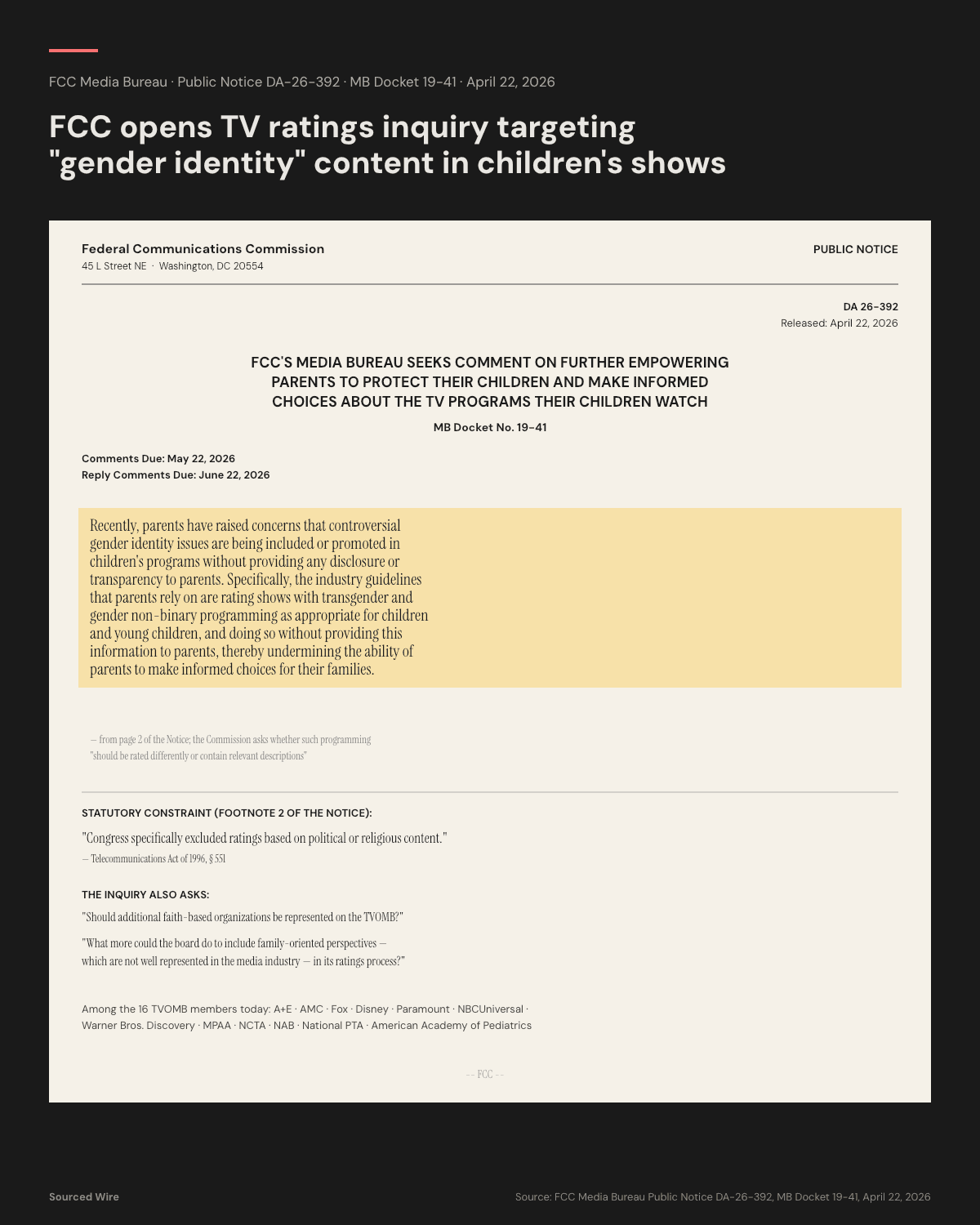
The Federal Communications Commission's Media Bureau on Tuesday opened a public proceeding asking whether the voluntary TV ratings system should be changed to flag "gender identity" content in children's programming — and whether the body that runs the ratings, the TV Oversight Management Board, should add "faith-based organizations" to its membership. The inquiry, Public Notice DA-26-392, sets a May 22 deadline for initial public comments and a June 22 deadline for replies, and reopens MB Docket 19-41, originally launched after Congress directed an FCC review of the ratings system in 2019.
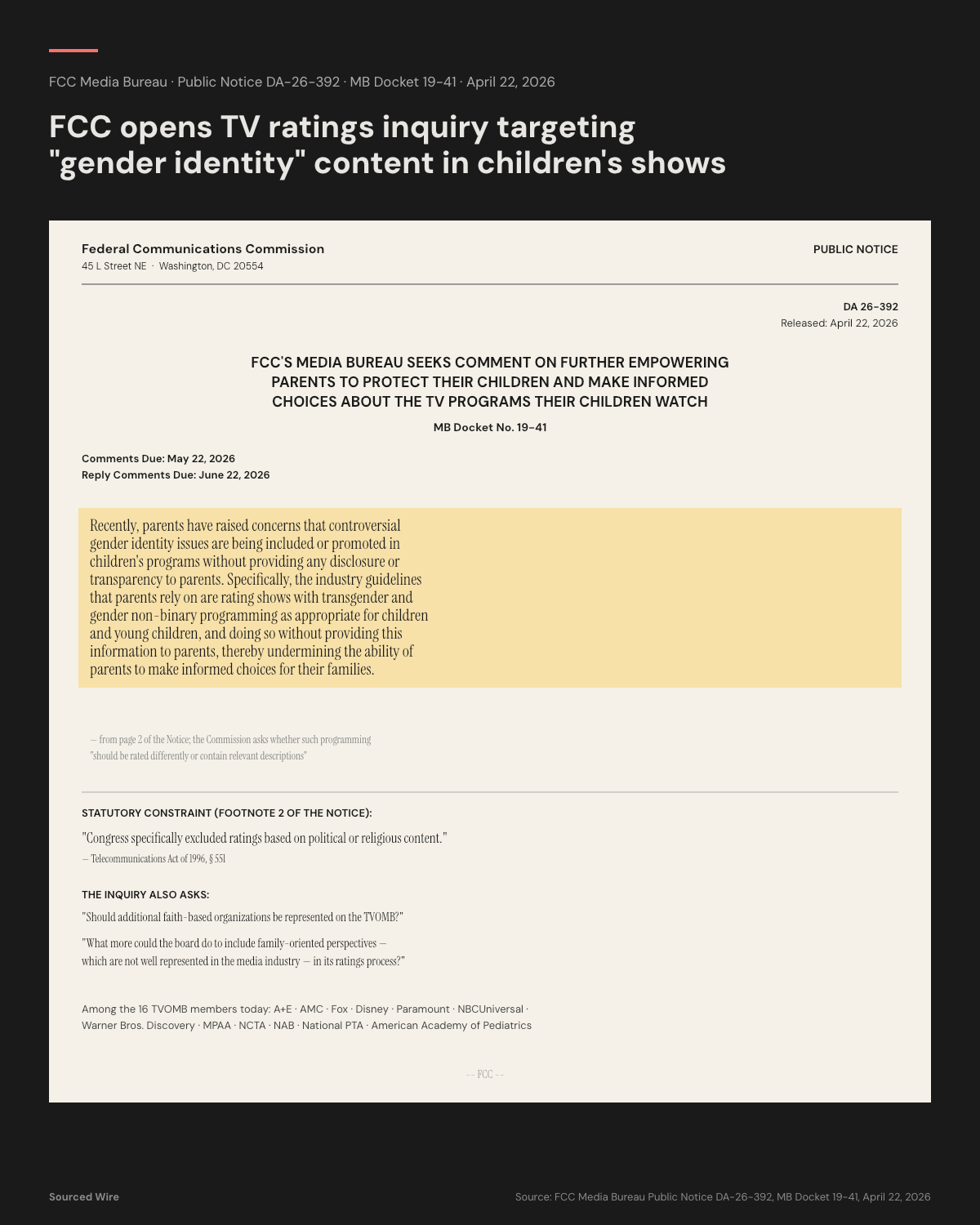
What the Notice asks
The heart of the Notice is a single paragraph on page 2: "Recently, parents have raised concerns that controversial gender identity issues are being included or promoted in children's programs without providing any disclosure or transparency to parents. Specifically, the industry guidelines that parents rely on are rating shows with transgender and gender non-binary programming as appropriate for children and young children, and doing so without providing this information to parents, thereby undermining the ability of parents to make informed choices for their families."
The Bureau then asks whether "such programming should be rated differently or contain relevant descriptions so that parents can make informed decisions," and asks the same question about the ratings tiers TV-Y (programs designed for very young children, ages 2–6), TV-Y7 (children 7 and up), and TV-G (suitable for all ages).
The Notice also asks how the TV Oversight Management Board (TVOMB) — the industry body that maintains the voluntary TV Parental Guidelines — should change its composition. Two of the explicit questions: "What more could the board do to include family-oriented perspectives — which are not well represented in the media industry — in its ratings process? Should additional faith-based organizations be represented on the TVOMB?" An accompanying footnote cites a statement from the U.S. Conference of Catholic Bishops.
The statutory carve-out the Notice itself acknowledges
The Notice's own footnote 2 cites the relevant section of the Telecommunications Act of 1996 (Pub. L. 104-104, § 551), the law that authorized the voluntary ratings system, the V-chip, and the FCC's ability to step in if industry failed to set up acceptable guidelines. The footnote reads in full: "Congress specifically excluded ratings based on political or religious content."
The Bureau did not address how that exclusion interacts with an inquiry that frames "gender identity" content as a category for new ratings descriptors and proposes adding faith-based organizations to the body that writes them.
Who's on the TVOMB today
The Notice provides a current snapshot of the 16-member board. Half are media companies whose programming is being rated: A+E Networks, AMC Networks, Fox Corporation, NBCUniversal, Paramount, TelevisaUnivision, The Walt Disney Company, and Warner Bros. Discovery. Four members are media trade associations: the MPAA, NCTA – The Internet and Television Association, the National Association of Broadcasters, and the Entertainment Industries Council. The four non-industry members are the American Academy of Pediatrics, the Boys & Girls Club of America, the National PTA, and Entertainment Industries Council.
The Notice also flags how little public correspondence the board reports it receives. According to the TVOMB's own 2025 annual report (cited in the Notice's footnotes), the Board logged just 11 pieces of public correspondence relevant to its work over the year, four of them involving streaming services. Spot checks led to two ratings changes.
Process and stakes
The proceeding is a "permit-but-disclose" docket under FCC ex parte rules, meaning lobbying meetings with Commission staff must be disclosed in writing within two business days. Comments and replies will be filed publicly through the FCC's Electronic Comment Filing System.
If the FCC ultimately concluded the voluntary system was inadequate, the 1996 statute gives the Commission authority to establish a ratings system itself — but only "if program distributors failed, after one year from the enactment date, to develop a voluntary rating system acceptable to the Commission." The Commission accepted the industry system in 1998. Any move beyond comment-gathering toward Commission-imposed ratings descriptors for specific identity categories would test both the 1996 statute's political/religious carve-out and First Amendment limits on government speech regulation that have governed FCC indecency rulings for decades.
The Notice does not announce any rule change. It opens a comment period.