Virginia's April 21 Vote: Why Congressional Control Now Depends on Who Draws the Maps
Of 435 U.S. House seats in 2026, only 18 are rated genuine toss-ups. Whoever draws the other 417 mostly determines which party wins them. Virginia voters are deciding today whether to let the General Assembly redraw the state's districts to shift four seats toward Democrats — enough, in a chamber where Republicans hold a 218-213 majority, to potentially decide U.S. House control for the 2027-2028 Congress. Polls close 7 p.m. ET.
Of the 435 seats in the U.S. House of Representatives, only 18 are rated as genuine toss-ups for the 2026 cycle by the Cook Political Report. Whoever draws the other 417 districts mostly determines which party wins them. That math is why today's special election in Virginia — a vote on whether the state legislature can redraw its congressional map — may decide which party controls the U.S. House for the 2027-2028 Congress.
Virginia's proposed map, already approved by the General Assembly and awaiting voter ratification today, is projected to shift the state's delegation from 6-5 Democratic to 10-1. That's a net four-seat gain for Democrats, larger than the three-seat margin separating the parties in the current U.S. House (218 Republicans, 213 Democrats, 4 vacancies). If voters approve the amendment and Democrats win the newly drawn seats in November, Virginia alone could flip control of Congress.
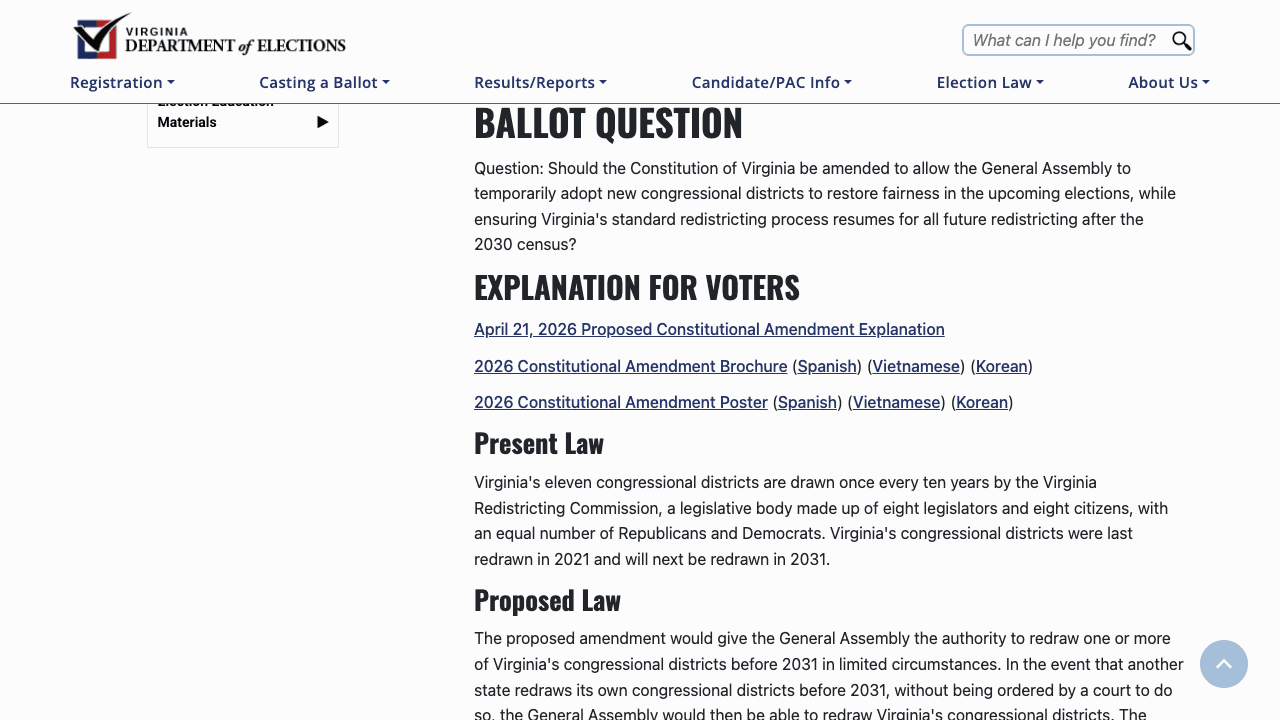
The ballot question, as it appears to voters:
Should the Constitution of Virginia be amended to allow the General Assembly to temporarily adopt new congressional districts to restore fairness in the upcoming elections, while ensuring Virginia's standard redistricting process resumes for all future redistricting after the 2030 census?
Polls close at 7 p.m. ET.
How U.S. House elections became a map-drawing contest
The U.S. Constitution assigns redistricting to state legislatures (Article I, Section 4). For most of American history, courts — both state and federal — reviewed partisan maps for fairness. That changed on June 27, 2019.
In Rucho v. Common Cause, a 5-4 Supreme Court majority ruled that partisan gerrymandering claims are "political questions beyond the reach of the federal courts." Federal judges can still strike down maps that discriminate by race. But partisan gerrymanders — no matter how aggressive — are outside federal jurisdiction entirely. The only remaining checks on partisan map-drawing are state constitutions, state supreme courts, and ballot measures passed by voters.
In practice, that created a regime where partisan control of the U.S. House depends on two things: how many state legislatures each party fully controls, and how aggressively those legislatures are willing to draw maps. States with divided control can't partisan-gerrymander much. States with unified single-party control can. Red states became redder in Congress, blue states became bluer, and the number of genuinely competitive seats shrank each cycle.
The 18-of-435 number is the product of that system. Not because American voters have sorted themselves into uniform geographic blocs — they haven't fully — but because maps have been drawn to amplify clustering wherever it benefits the party holding the pen. The result is a structural decoupling of congressional representation from voting: most House seats are decided at the map-drawing stage, and the general election is a ratification of outcomes already built in.
The Rucho-era arms race
Since 2019, states have responded to the Supreme Court's withdrawal in two opposite directions.
One group — Michigan, Colorado, Virginia, California — passed voter-approved amendments creating independent redistricting commissions. The goal was to remove partisan map-drawing from legislatures by constitutional design. Virginia's amendment passed in November 2020 with 65.7% of the vote, creating a 16-member commission split evenly between the two parties and between legislators and citizens. Only Arlington County voted against.
The other group has redrawn congressional maps mid-decade to lock in partisan advantage. Texas redrew in 2023. North Carolina's state supreme court reversed its own earlier anti-gerrymander ruling, clearing the way for a new Republican-drawn map. Ohio's maps have been redrawn multiple times since 2022. Each redraw shifted projected seats toward Republicans.
States with independent commissions watched this happen without any federal remedy available. Their options narrowed to two: accept the structural disadvantage of holding to reform while other states press advantage, or use their own legislatures to respond in kind. Virginia's amendment is the first major test of the second path.
What the amendment does
A Yes vote amends Article II, Section 6 of the Virginia Constitution to give the General Assembly authority to modify congressional districts between January 1, 2025 and October 31, 2030 — conditional on another state having redistricted outside the normal decennial cycle and without court order. Texas, North Carolina, and Ohio have all met that trigger.
A Yes vote also gives effect to House Bill 29, the pre-approved map Governor Abigail Spanberger signed on February 20, 2026. The new districts take effect for the 2026, 2028, and 2030 U.S. House elections. Redistricting authority returns to the Virginia Redistricting Commission after the 2030 census.
A No vote leaves current districts in place. The Virginia Redistricting Commission retains sole authority to redraw maps after the 2030 census. No boundary changes occur before 2031.
What the proposed map actually changes
Current Virginia delegation: 6 Democrats, 5 Republicans. Projected delegation under the proposed map, based on 2025 gubernatorial election results: 10 Democratic-leaning seats, 1 Republican-leaning.
Three Republican-held or competitive seats become newly competitive or Democratic-leaning:
| District | Current lean | Proposed lean |
|---|---|---|
| 1st | 58.0% R | 49.6% R |
| 5th | 55.4% R | 51.2% R |
| 6th | 61.2% R | 50.6% R |
| 9th (rural SW) | Safe R | Safe R (unchanged) |
Two Democratic-leaning districts become less safe, releasing Democratic voters into the newly competitive districts:
| District | Current lean | Proposed lean |
|---|---|---|
| 4th | 65.4% D | 57.2% D |
| 8th | 73.0% D | 57.6% D |
Two populous counties see sharply more district splits: Prince William goes from 2 districts to 5, Fairfax from 3 to 5. Splitting populous, partisan-dense counties across multiple districts is the core mechanic of partisan gerrymandering — it dilutes a concentrated bloc by combining pieces of it with different surrounding areas.
The choice voters are being asked to make
The ballot language uses the word "fairness." But a fairness amendment would empower the redistricting commission to respond to other states' moves, not replace it with the legislature. What's actually on the ballot is a choice between two responses to the Rucho regime.
Vote Yes: Virginia enters the mid-decade arms race. Four seats shift toward Democrats, potentially deciding U.S. House control. The 2020 commission is paused for three election cycles.
Vote No: The 2020 commission stands. Virginia's congressional delegation stays underweight Democratic relative to its statewide voting while Republican-drawn mid-decade maps in other states continue to shape U.S. House control.
Neither outcome resolves the underlying structural condition that made this vote necessary: congressional majorities are now decided by state legislatures' willingness to draw aggressive maps, not by statewide voter preferences. That problem sits at the federal level — a 5-4 Supreme Court decision, and a Congress that has repeatedly failed to pass federal redistricting reform. Neither federal branch looks likely to revisit it soon.
So Virginia voters are settling something the federal system declined to settle.
Supporters and opponents
Yes campaign: former President Barack Obama, Governor Spanberger, Senators Tim Kaine and Mark Warner, former Attorney General Eric Holder. Virginians for Fair Elections reports approximately $49 million raised as of April 6.
No campaign: former Governor Glenn Youngkin, President Donald Trump, Vice President JD Vance, House Speaker Mike Johnson. Virginians for Fair Maps raised approximately $9 million; Justice for Democracy PAC, financed by Peter Thiel, raised over $5 million for opposition.
The polling
Five public polls conducted between January and April 2026:
| Pollster | Dates | Yes | No | Undecided |
|---|---|---|---|---|
| State Navigate | Apr 10–13 | 51% | 45% | 4% |
| Washington Post / Schar School | Mar 26–31 | 52% | 47% | 2% |
| Neighborhood Research | Apr 1–3 | 45% | 46% | 9% |
| Roanoke College | Feb 9–16 | 44% | 52% | 4% |
| Christopher Newport University | Jan 13–20 | 51% | 43% |
The three most recent polls (all April) showed Yes narrowly ahead or tied; two earlier polls found No leading.
Legislative path
Virginia constitutional amendments require passage by two separately elected General Assemblies before going to voters.
| Date | Action |
|---|---|
| Oct 29, 2025 | House passes HJ 4, first session (51–42) |
| Oct 31, 2025 | Senate passes HJ 4, first session (21–16) |
| Jan 14, 2026 | House passes HJ 4, second session (62–33) |
| Jan 16, 2026 | Senate passes HJ 4, second session (21–18) |
| Feb 4, 2026 | Gov. Spanberger signs HB 1384 scheduling the special election |
| Feb 20, 2026 | Gov. Spanberger signs HB 29, the proposed map |
| Apr 21, 2026 | Special election — polls 6 a.m. to 7 p.m. ET |
Results will be reported after 7 p.m. ET by the Virginia Department of Elections. What happens next depends on whether Virginia's vote escalates or halts the mid-decade redistricting cycle — and ultimately, whether Congress or the Supreme Court ever revisits the federal question the states are now answering piecemeal.